

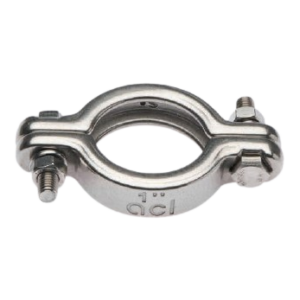
Euro-Pure 316L Double Nut Clamp
A clamp consists of two half-shells joined by a hinge and closed by a tightening mechanism. On a tri-clamp connection, sealing is achieved by compressing the gasket between the two ferrule faces. The clamp holds this compression and determines how it is distributed around the gasket circumference.
The Euro-Pure design is based on a body hot-forged to EN 10243-1. For equal or greater strength, the clamp takes up considerably less space than a cast reinforced version: 18 mm band width instead of 26 mm across the entire range.
Advanced Coupling Clamp Specification
Euro-Pure 316L clamps, forged body, double bolt
Hot-forged to EN 10243-1, hex nuts, 1/2″ to 4″, DN8 to DN100
Clamp with hot-forged body, two bolted segments, two bolts with spring washers and hex nuts. 316L stainless steel body, grade 1.4404. Six sizes from 1/2″ to 4″, i.e. DN8 to DN100, compatible with DIN 32676, ISO 2852 and ASME BPE ferrules. Band width of 18 mm versus 26 mm on a conventional reinforced clamp, with higher pressure rating. AD2000-A5 qualification obtained.
31 percent narrower
This is the primary reason for buying this clamp, ahead of pressure and grade. Across the entire range above 1″, the band width is 18 mm, whereas a conventional reinforced double-bolt clamp is 26 mm. The radial footprint follows the same logic, with 12 to 13 mm less at each diameter.
| Flange A (mm) | Euro-Pure width | Conventional reinforced width | Euro-Pure radius | Conventional reinforced radius |
| 50,5 | 18 mm | 26 mm | 52 mm | 64 mm |
| 64 | 18 mm | 26 mm | 61 mm | 73 mm |
| 77,5 | 18 mm | 26 mm | 68 mm | 80 mm |
| 91 | 18 mm | 26 mm | 73 mm | 86 mm |
| 119 | 18 mm | 26 mm | 89 mm | 102 mm |
Eight millimetres less band width translates directly into centre distance on a line. Two back-to-back fittings move 16 mm closer together, a rack of six parallel lines gains nearly 5 cm in width, and an insulated fitting regains the shell thickness it was missing. On a skid, these millimetres often decide whether a layout is feasible.
The reduction in radius matters just as much. A clamp that protrudes less around the tube leaves room for the wrench, allows mounting against a wall or under a frame, and eliminates interference with neighbouring supports.
At 1/2″, the two versions are equivalent, 18 mm versus 16 mm. The difference only appears from 1″ upwards, and then remains constant.
Forged: what makes compactness possible
The body is hot-forged to EN 10243-1, whereas almost all clamps on the market are cast.
Forging aligns the metal grain flow with the geometry of the part instead of leaving it random. It eliminates the porosity and shrinkage cavities inherent in casting, which are all potential crack initiation points in the most highly loaded areas, hinges and bolt seats. For the same cross-section, the forged part withstands more.
The designer can therefore remove material where it does no work. This is what makes it possible to go down to an 18 mm band without losing strength, and it is also the basis of the reduced carbon footprint argument: less material per part, over the entire life cycle.
Pressure, with a reversal at 4″
On small diameters, the gain is substantial: 140 bar at 1/2″ and 125 bar at 1″, compared with 75 bar for a conventional reinforced clamp and 50 bar for an SH. At 2″, 95 bar versus 75 and 50.
The gap then narrows, and reverses. At 3″, 70 bar versus 60. At 4″, 40 bar versus 53: the conventional reinforced clamp pulls ahead. This point deserves to be stated clearly, as it determines the choice.
Purchasing reasoning therefore follows two regimes. Up to 3″, the Euro-Pure combines compactness and pressure. At 4″, only compactness, grade 316L and PED qualification remain, which is often still sufficient but must be weighed up.
The only PED qualification obtained
The Euro-Pure is AD2000-A5 approved. On the manufacturer’s other ranges, qualification is announced as in progress, which is not the same thing in a technical file.
For pressure equipment falling under Directive 2014/68/EU, this is the difference between a component whose compliance has been demonstrated and a component that must be justified by other means. On a skid intended to carry CE marking, this question is not negotiable at the file review stage.
The grade is also consistent throughout the documentation: 316L, 1.4404. This is significant when material traceability is part of the qualification file, and it sets this range apart from cast versions.
Construction and tightening
Two bolted segments, two diametrically opposed bolts, spring washers, hex nuts. Polished finish.
The spring washers maintain stud preload during thermal cycles, which limits gradual loosening on steam lines and circuits subjected to repeated SIP. Tightening is carried out in alternating passes on both bolts, as on a flange, up to the specified torque.
The hex nut requires a wrench. The torque becomes a value that is applied, read and recorded, and opening is no longer possible by hand. On qualified points, both of these properties are expected.
Material
316L stainless steel body, grade 1.4404. The clamp remains outside the process and comes into contact neither with the fluid nor with internal CIP solutions. It is, however, exposed to floor washdowns, ambient steam, splashes of alkaline detergents and, in microelectronics, acidic atmospheres. 316L limits the onset of crevice corrosion in overlapping areas.
Pressure rating
The maximum allowable pressure depends on the diameter. It applies to the clamp alone.
| Diameter | DN equivalent | Flange A (mm) | MAWP (bar) |
| 1/2″ to 3/4″ | DN6 to DN10 | 25,4 | 140 |
| 1″ to 1 1/2″ | DN25 to DN40 | 50,5 | 125 |
| 2″ | DN50 | 64 | 95 |
| 2 1/2″ | DN50 (ISO) | 77,5 | 90 |
| 3″ | DN65 | 91 | 70 |
| 4″ | DN100 (DIN) | 119 | 40 |
The allowable pressure of the complete assembly depends on the gasket, its material, the operating temperature and the ferrule tolerances. The values in the table are the mechanical limit of the clamp at ambient temperature, not that of the connection. At 140 bar, the gasket becomes by far the limiting link: no standard elastomer can keep up with the clamp in this range.
Standards compatibility
The clamp is defined by the outside diameter of the ferrule face, not by the tube DN. It therefore applies equally to ferrules made to DIN 32676 series A, B and C, ISO 2852 and ASME BPE, provided the flange diameter matches.
Depending on the case, the associated tubes conform to DIN 11850, EN 10357 series A to C, DIN 11866 or ISO 2037. The hygienic classes H3, H4 and H5 of DIN 11866 make it possible to trace the correspondence between tube, fitting and internal surface finish.
Gasket selection
The clamp is independent of the gasket. The elastomer material, EPDM, silicone, FKM or PTFE, is selected based on chemical compatibility and operating temperature, then on the food or pharmaceutical compliance requirements applicable to the project.
On this range more than any other, this question is decisive. A clamp rated at 140 bar combined with a standard EPDM gasket gives a connection that holds what the EPDM holds, not what the clamp holds. Going higher in pressure requires an enveloped gasket, a gasket with a metal insert or a suitable face geometry. The clamp’s MAWP is only a ceiling.
A tightening torque also only makes sense in combination with a given gasket material and thickness. Any value recorded during qualification must specify the gasket reference.
Overall dimensions
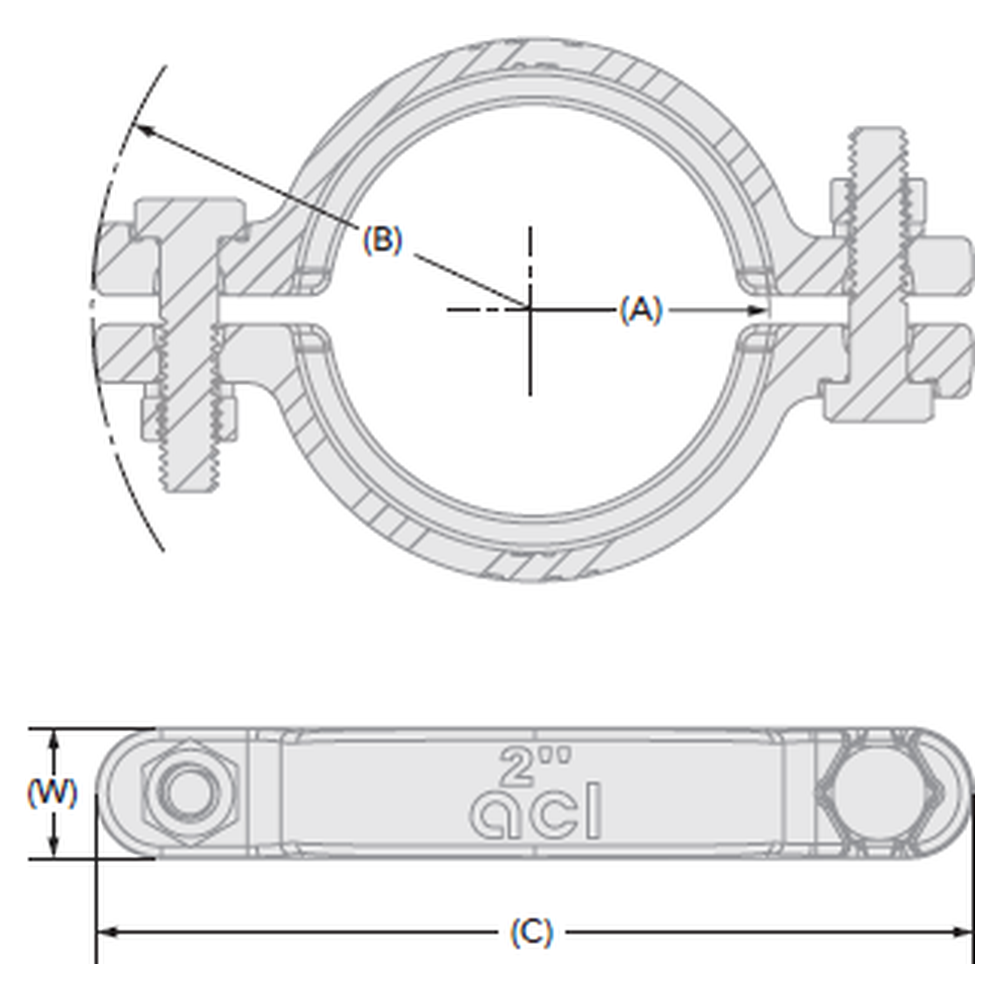
Band width of 18 mm across the entire range, versus 26 mm on a cast reinforced version. Radial footprint from 38 mm at 1/2″ to 89 mm at 4″. Overall length from 73 mm to 170 mm. Flange diameter from 25.4 mm to 119 mm.
As the two bolts are diametrically opposed, allow wrench clearance on both sides of the fitting. This is the only installation constraint this clamp adds compared with a single-bolt clamp.
Applications
Pharmaceutical and biotechnology industries, high-pressure process lines, homogenisation, pressurised transfers, solvent distribution, fine chemicals, microelectronics, pressure equipment subject to CE marking.
Periodic inspections by third-party bodies. Clamps calibrated from batch to batch to ensure consistent fit on the ferrule. Design developed to reduce the carbon footprint over the entire life cycle. Packed in cardboard, plastic-free.
Technical specifications
| Characteristic | Value |
| Type | Euro-Pure, 2 bolted segments, double bolt |
| Body material | 316L stainless steel, 1.4404 |
| Manufacturing | Hot-forged to EN 10243-1, polished finish |
| Fasteners | 2 bolts, spring washers, hex nuts |
| Qualification | AD2000-A5 (PED) obtained |
| Size range | 1/2″ to 4″ (DN8 to DN100) |
| Flange diameter | 25.4 mm to 119 mm |
| Band width | 18 mm across the entire range (26 mm on a cast reinforced clamp) |
| MAWP | 140 bar at 1/2″ to 40 bar at 4″ |
| Compatible ferrules | DIN 32676 series A, B, C, ISO 2852, ASME BPE |
| Tightening | To torque, in alternating passes on both bolts |
| Delivery | Assembled, ready to install |
| Packaging | Cardboard, plastic-free |
Dimensional drawing key: A flange diameter (ferrule face), B opening radius, C overall length, W band width.
Clamp and ferrule correspondence
The clamp flange diameter A corresponds to the outside diameter of the ferrule face, not to the tube DN. A DN25 tube fitted with a 1″ ferrule takes a clamp with a 50.5 mm flange. The table below gives the equivalence between clamp size, ferrule size and tube diameter for the ASME BPE, DIN 32676 and ISO 2852 standards.
Other clamp versions
The Euro-Pure stands out for its compactness and its qualification. The other versions meet different needs.
| Version | Closure | Use |
| Forged Euro-Pure | 2 bolts, 2 bolted segments | Reduced footprint and PED, from 140 to 40 bar, 1/2″ to 4″ |
| Reinforced SSH | 2 bolts, 2 separate segments | High loads in 304L, from 75 to 20 bar, up to 12 5/8″ |
| SH double bolt, wing nut | 2 adjustable swing bolts | Symmetrical tightening, 2 1/2″ to 10″ |
| Safety, 4 levels | 1 shouldered eye bolt, 2 pins | Points where accidental opening under pressure must be prevented |
| SH single bolt, double hinge | 1 bolt, 2 pins | Process connections from 50 to 10 bar, DN8 to DN300 |
| SL single hinge | 1 bolt, 1 pin | Utilities and service connections, from 25 to 17 bar |
| Three segments | 1 bolt, 3 riveted segments | Frequent one-handed opening, from 21 to 12 bar |
Frequently asked questions
Exactly how much space is saved?
Eight millimetres less band width across the entire range above 1″, i.e. 18 mm versus 26. And 12 to 13 mm less radius at each diameter. On a rack of six parallel lines, this represents nearly 5 cm of width recovered.
Euro-Pure or reinforced SSH?
Up to 3″, the Euro-Pure wins on both counts: more compact and stronger, 140 bar versus 75 at 1/2″. At 4″, pressure reverses, 40 bar versus 53, and only compactness, 316L and PED remain. The SSH also covers a much wider range, up to 12 5/8″.
Why choose the Euro-Pure at 4″ if the reinforced clamp holds more?
For three reasons that have nothing to do with pressure: 8 mm less band width, grade 316L instead of 304L, and AD2000-A5 qualification obtained. If none of these matters in your case and you need more than 40 bar, the conventional reinforced clamp is the right choice.
Can 140 bar really be used?
Not with a standard gasket. At this level, it is the gasket that sets the limit of the connection, well below that. The clamp’s MAWP is a ceiling, not a service performance. The design of the complete connection must be reviewed, gasket included.
How do I choose the size?
The choice is based on the outside diameter of the ferrule, dimension A. The tube DN is not enough: a DN25 exists with a 34 mm ferrule and with a 50.5 mm ferrule, depending on the standard. The Euro-Pure range does not cover the 34 mm flange.
Which pressure should be used for a technical file?
That of the gasket under its actual operating conditions. The stated MAWP value applies to the clamp alone, at ambient temperature.