
Mesh Screen Gasket FDA USP Class VI
On a tri-clamp connection, the gasket does more than seal. Some versions add a function: filtering, regulating, measuring or validating, directly at the connection plane, with no add-on device on the line.
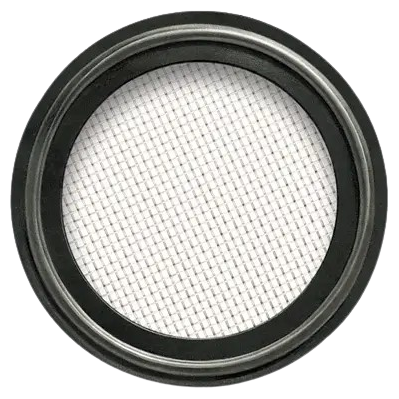
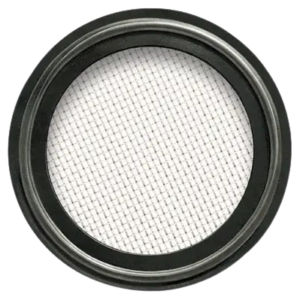
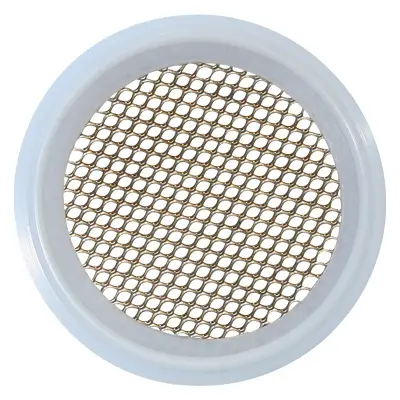
The screen gasket is a standard gasket whose centre is occupied by a stainless steel sieving mesh. It filters particles directly in the line, in place of an ordinary gasket, without a strainer or add-on filter housing.
Rubber Fab materials and chemical compatibility guide
Rubberfab screen gasket references
316 stainless steel mesh, 4 to 325 mesh, filtration from 5,156 to 43 microns
Tri-clamp screen gasket, 316 stainless steel sieving mesh crimped into an elastomer or PTFE sealing gasket. Filters particles in line, interchangeable with a standard gasket. Mesh from 4 mesh to 325 mesh, i.e. from 5,156 to 43 microns, and filter cloths down to 10 microns. FDA and USP Class VI compliant. Sizes from 1/2″ to 6″. Available in a metal-detectable version.
Filtering without a filter housing
The screen gasket replaces a standard gasket and adds a filtration function at the connection point. It protects a pump, a valve or downstream equipment from particles, acts as a prefilter upstream of an expensive membrane, or retains particles in sterile filling products.
The mesh is chosen according to the required fineness. Coarse meshes, 4 to 20 mesh, stop foreign bodies and large debris. Fine meshes, 100 to 325 mesh, go down to 43 microns. Woven filter cloths, combined with a support mesh, reach 10 microns for critical prefiltration.
The peripheral sealing gasket is available in the standard materials, EPDM, PTFE, FKM and silicone, which matches the chemical compatibility and temperature range of the screen to those of the line. A reinforced support, 10 mesh backer, holds fine cloths in place under flow.
Characteristics
| Characteristic | Value |
| Type | Screen gasket, crimped sieving mesh |
| Mesh cloth | 316 stainless steel, woven or filter cloth |
| Mesh size | 4 mesh (5,156 µm) to 325 mesh (43 µm), cloths down to 10 µm |
| Peripheral gasket | EPDM, PTFE, FKM or silicone |
| Compliance | FDA, USP Class VI |
| Sizes | 1/2″ to 6″ |
| Option | Metal-detectable, 10 mesh support |
Dimensions and correspondence
The gasket is fitted like a standard gasket, on the outside diameter of the ferrule face. The clamp, ferrule and tube correspondence table, common to all versions, is available for download.
The gasket: the sensitive link in the clamp fitting
The quality of a clamp connection depends on three elements: the gasket, the clamp and pipe alignment. A version with an added function, screen, orifice or measurement port, places more stress on the gasket than a solid gasket. A stressed installation or excessive tightening damages it more quickly. Compression is achieved at the torque specified for the clamp, never by feel.
Frequently asked questions
Which mesh size should I choose?
It depends on the size of the particles to be retained. 4 to 20 mesh for debris and foreign bodies, 100 to 325 mesh for fine filtration down to 43 microns, filter cloths to go down to 10 microns. The manufacturer’s filtration guide helps convert between mesh and microns.
Screen or basket gasket?
The screen filters flat at the gasket plane, with a small footprint and limited retention capacity. The basket, or sock, extends into the tube and offers much more surface area, and therefore more capacity before clogging. Screen for a clean flow, basket for a high volume of particles.
Does the screen withstand the same temperature as the gasket?
Yes, the range is that of the peripheral gasket material. A screen with a PTFE gasket withstands higher temperatures than a screen with an EPDM gasket.