
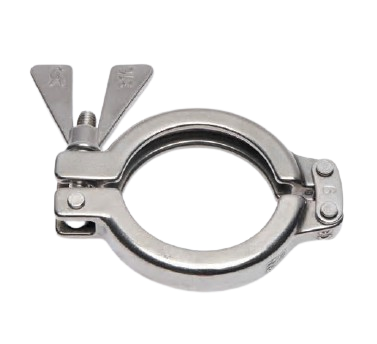
SH 316 Double-Hinge Clamp
Advanced Coupling clamp specification
A clamp consists of two half-shells connected by a hinge and closed by a tightening mechanism. On a tri-clamp connection, sealing is ensured by compressing the gasket between the two ferrule faces. The clamp holds this compression and determines how it is distributed around the gasket circumference.
The SH design combines a single tightening screw with two hinges. The clamp’s maximum allowable pressure ranges from 50 bar at 1/2″ to 10 bar at 12″.
The SH 316 clamp is a single-screw, double-hinge clamp with a 316 stainless steel body.
Diameters from 1/2″ to 12 5/8″, i.e. DN8 to DN300, compatible with DIN 32676, ISO 2852 and ASME BPE ferrules.
Maximum allowable pressure from 50 bar at 1/2″ to 10 bar at 12″, calculated according to ASME VIII Div. 1 App. 24.
Supplied assembled, with wing nut or hex nut.
Two-axis closure
A single-hinge clamp closes by rotating around a single axis. The free half-shell approaches the ferrule at an angle and loads the gasket laterally before compression. This kinematics promotes gasket displacement and marking of the sealing faces.
The two-axis design allows both half-shells to bear parallel onto the flanges. The clamp self-centres on both ferrules, the load is distributed around the entire circumference and the gasket is not sheared during closure. Tightening is done with a single screw, without having to hold the shell during the operation.
This feature is sought after on lines that are frequently dismantled: periodic gasket changes, manual cleaning, restricted access, diameters above 4″ where the weight of the shell makes manual holding difficult.
Material and surface finish
316 stainless steel body
The clamp remains outside the process and is in contact neither with the fluid nor with internal CIP solutions. It is, however, exposed to floor washing, ambient steam, splashes of alkaline detergents and, in microelectronics, acidic atmospheres. The surface finish and the 316L grade limit the onset of crevice corrosion in the overlapping areas of the hinges.
The fasteners receive a treatment designed to limit galling. On reinforced double-screw versions, some manufacturers fit brass nuts up to 4″ to preserve the threads during repeated dismantling cycles.
Pressure rating
The maximum allowable pressure depends on the diameter. It is calculated according to ASME VIII Division 1, Appendix 24, and applies to the clamp alone.
| Diameter | DN equivalent | Flange A (mm) | MAWP (bar) |
| 1/2″ to 2 1/2″ | DN8 to DN50 | 25.4 to 77.5 | 50 |
| 3″ and 3 1/2″ | DN65 and DN80 | 91 and 106 | 40 |
| 4″ | DN100 (DIN) | 119 | 35 |
| 4 1/2″ to 6″ | DN100 (ISO) to DN125 | 130 to 167 | 30 |
| 6 5/8″ | DN150 | 183 | 25 |
| 8″ and 8 5/8″ | DN200 | 217.4 and 233.5 | 20 |
| 10″ and 10 5/8″ | DN250 | 268 and 286.1 | 16 |
| 12″ and 12 5/8″ | DN300 | 319 and 338 | 10 |
The allowable pressure of the complete assembly depends on the gasket, its material, the operating temperature and the ferrule tolerances. The values in the table represent the mechanical limit of the clamp at ambient temperature, not that of the connection.
Standards compatibility
The clamp is defined by the outside diameter of the ferrule face, not by the tube DN. It therefore applies equally to ferrules made to DIN 32676 series A, B and C, ISO 2852 and ASME BPE, provided the flange diameter matches.
The associated tubes fall, depending on the case, under DIN 11850, EN 10357 series A to C, DIN 11866 or ISO 2037. The DIN 11866 hygienic classes H3, H4 and H5 make it possible to trace the correspondence between tube, fitting and internal surface finish.
Gasket selection
The clamp is independent of the gasket. The elastomer material, EPDM, silicone, FKM or PTFE, is chosen based on chemical compatibility and operating temperature, then on the food or pharmaceutical compliance requirements applicable to the project. It is this choice that sets the allowable temperature of the connection, not the clamp.
Dimensions
Band width of 17 mm on diameters up to 4 1/2″, 19 mm at 5″, 24 mm from 5 1/2″. Overall length from 75 mm to 430 mm depending on size. Flange diameter from 25.4 mm to 338 mm.
Fields of application
Pharmaceutical and biotechnology industries, PW and WFI loops, process lines, solvent distribution, microelectronics, cosmetics, food processing.
A design in service for more than 30 years. Periodic inspections by third-party bodies. Clamps calibrated between batches to ensure consistent fit on the ferrule. Packed in cardboard, plastic-free.
Technical characteristics
| Characteristic | Value |
| Type | SH, single-screw, double hinge (2 axes) |
| Body material | 316 stainless steel |
| Fasteners | Wing nut or hex nut, anti-galling treatment |
| Size range | 1/2″ to 12 5/8″ (DN8 to DN300) |
| Flange diameter | 25.4 mm to 338 mm |
| Band width | 17, 19 or 24 mm depending on diameter |
| MAWP | 50 bar at 1/2″ to 10 bar at 12″, ASME VIII Div. 1 App. 24 |
| Compatible ferrules | DIN 32676 series A, B, C, ISO 2852, ASME BPE |
| Delivery | Assembled, ready to install |
| Packaging | Cardboard, plastic-free |
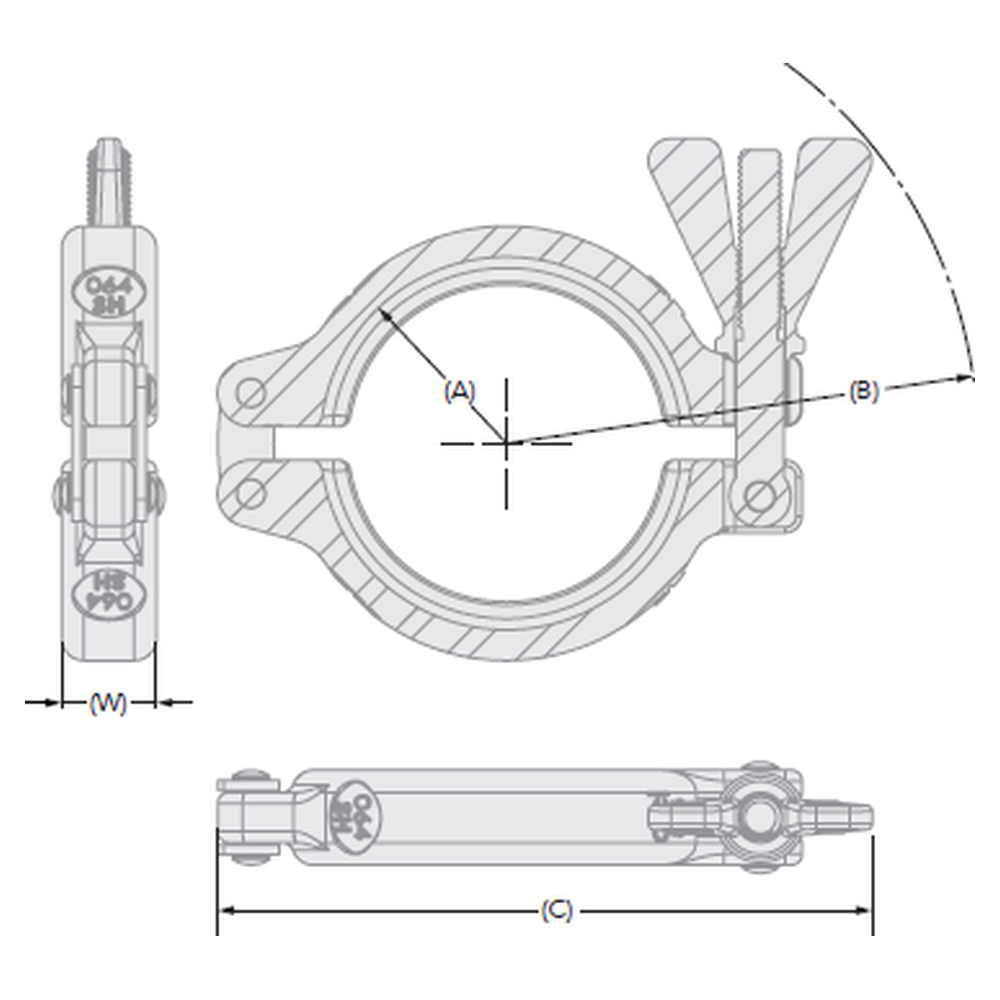
Dimensional drawing key: A flange diameter (ferrule face), B opening radius, C overall length, W band width.
Clamp and ferrule correspondence
The clamp flange diameter A corresponds to the outside diameter of the ferrule face, not to the tube DN. A DN25 tube fitted with a 1″ ferrule takes a 50.5 mm flange clamp. The same DN25 fitted with a DIN ferrule takes a 34 mm flange clamp. The table below gives the equivalence between clamp size, ferrule size and tube diameter for the ASME BPE, DIN 32676 and ISO 2852 standards.
Other clamp versions
The SH covers the majority of process connections. The other versions address specific constraints.
| Version | Closure | Use |
| SH single-screw, double hinge | 1 screw, 2 axes | Standard connections from 50 to 10 bar depending on diameter, frequent dismantling |
| Double hex nut | 1 screw, 2 nuts | Controlled and traceable tightening torque |
| Anti-opening safety | Shouldered eye bolt and grooved housing | Points where accidental opening under pressure must be prevented, 1/2″ to 12 5/8″ |
| Reinforced double screw | 2 screws | Higher clamping forces for the same size, 1/2″ to 8 5/8″ |
| Three segments | 3 segments | Large diameters, load distribution over three faces |
| Polymer, single-use | Quick closure | Bags, filters and disposable lines, -70 °C to 60 °C |
On safety versions, the eye bolt cannot pivot until the nut has been loosened by the specified number of turns. The clamp therefore cannot open under impact while the connection is under pressure. Complete removal of the nut is not required for opening.
Single-use polymer clamps cover a standard range of -70 °C to 60 °C, freezing down to -80 °C, autoclaving up to 134 °C for 30 minutes and gamma sterilisation up to 50 kGy.
Frequently asked questions
What is the difference from a single-hinge clamp?
A single hinge is suitable for fittings installed once and rarely reopened. A double hinge brings a benefit on connections that are dismantled regularly: the gasket stays in place during closure and the sealing faces are less stressed. The difference becomes greater above 4″.
How do I choose the size?
The choice is based on the outside diameter of the ferrule, dimension A. The tube DN is not enough: a DN25 exists with a 34 mm ferrule and with a 50.5 mm ferrule depending on the standard.
Wing nut or hex nut?
The wing nut is suitable for connections dismantled by hand in production. The hex nut, or the double-nut version, is chosen when a tightening torque must be applied and recorded, particularly at points subject to qualification.
Is a safety clamp needed?
On circuits kept under pressure and exposed to passing traffic or impacts, the anti-opening version eliminates the risk of accidental uncoupling. On a line in a controlled area with restricted access, the standard SH is sufficient.
Compatibility with ferrules from other suppliers?
Yes, provided the flange diameter matches, regardless of the ferrule standard.
What pressure should be used for a technical file?
That of the gasket under its actual operating conditions. The MAWP value stated corresponds to the clamp alone, at ambient temperature.