

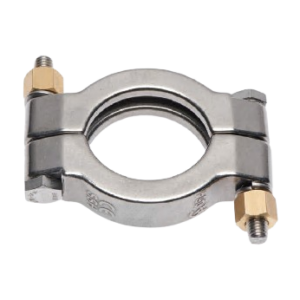
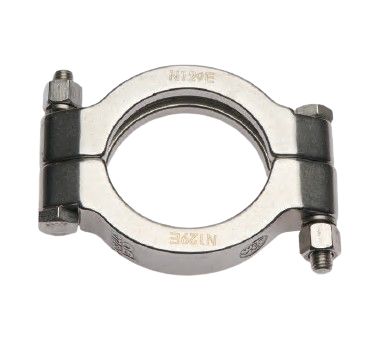
SSH 316 Double-Nut Clamp
An SSH clamp holds the gasket compression between the two ferrule faces and determines how it is distributed around the circumference. The higher the internal pressure, the greater the opening force applied to the flanges, and the greater the load the clamp must withstand.
The SSH design meets this constraint with two screws and two separate segments, without a hinge. It is calculated according to ASME VIII Division 1, Appendix 24, with a higher safety factor than single-screw clamps.
Advanced Coupling clamp specifications
Link to the Advanced Coupling website
SSH 304L clamps, high pressure, double screw
Two separate segments, hex nuts, 1/2″ to 12 5/8″, DN8 to DN300
High-pressure SSH clamp with two screws and two separate segments, 304L stainless steel body, 316 version on request. Diameters from 1/2″ to 12 5/8″, i.e. DN8 to DN300, compatible with DIN 32676, ISO 2852 and ASME BPE ferrules. Maximum allowable pressure from 75 bar at 1/2″ to 20 bar at 12 5/8″. Used in pharmaceuticals, chemicals, food processing and utilities, wherever pressure or line loads exceed what a single-screw clamp can withstand.
Why two screws
On a single-screw clamp, the entire clamping force passes through a single stud, opposite the hinge. Load distribution around the circumference is correct but reaches a ceiling, and the stud becomes the limiting point.
With two diametrically opposed screws and two independent segments, the force is distributed over two clamping points. The allowable load increases: 75 bar at 2″ versus 50 bar for an SH clamp of the same diameter. Spring washers maintain stud preload during thermal cycles, limiting progressive loosening on steam lines and circuits subject to repeated SIP.
The trade-off is handling time. The clamp is not held together once opened; it separates into two half-shells. On a line dismantled every day, a double-hinge clamp remains faster.
Frequently asked questions
SH or SSH?
Choose the SSH as soon as the operating pressure, temperature or loads transmitted by the pipework exceed the single-screw range. At 2″, the SSH is rated at 75 bar versus 50 bar for the SH. The SH remains the right choice for routinely dismantled connections, where ease of handling comes first.
Why brass nuts?
High torque applied to a stainless-on-stainless pairing causes thread galling after a few dismantlings. Brass, being softer, sacrifices the nut and preserves the stud. Sizes up to 4″ are supplied with brass nuts, sizes from 4 1/2″ with stainless steel nuts. The reverse is possible on request.
Two separate segments: what are the consequences for installation?
The clamp separates into two parts when opened. Both half-shells must be held while positioning them on the ferrules, which requires two hands, or even a helper above 6″. In return, tightening is symmetrical and the two screws are tightened alternately, as on a flange.
How do I choose the size?
On the outside diameter of the ferrule, dimension A, never on the tube DN. A DN25 exists with a 34 mm ferrule and with a 50.5 mm ferrule depending on the standard. The downloadable correspondence table gives the full equivalence.
304L or 316?
304L covers utilities, steam, compressed air and most process lines. 316 is justified in chloride atmospheres, by the sea, in wash rooms exposed to alkaline detergents, on halogenated solvent lines, and in installations with a humid environment.
What pressure should be used for a technical file?
That of the gasket under its actual operating conditions. The MAWP values correspond to the clamp alone, at ambient temperature. On a clamp fitting, it is almost always the gasket that sets the limit, not the clamp.
Technical characteristics
304L stainless steel body, 316 version on request. Two separate segments, two hex studs with spring washer.
| Characteristic | Value |
| Type | SSH, double screw, two separate segments |
| Body material | 304L stainless steel, 316 version on request |
| Fasteners | 2 hex studs, spring washers |
| Nuts | Brass up to 4″, stainless steel from 4 1/2″, reverse on request |
| Size range | 1/2″ to 12 5/8″ (DN8 to DN300) |
| Flange diameter | 25.4 mm to 338 mm |
| Band width | 16 to 30 mm depending on diameter |
| MAWP | 75 bar at 1/2″ to 20 bar at 12 5/8″, ASME VIII Div. 1 App. 24 |
| Compatible ferrules | DIN 32676 series A, B, C, ISO 2852, ASME BPE |
| Delivery | Assembled, ready to install |
| Packaging | Cardboard, plastic-free |
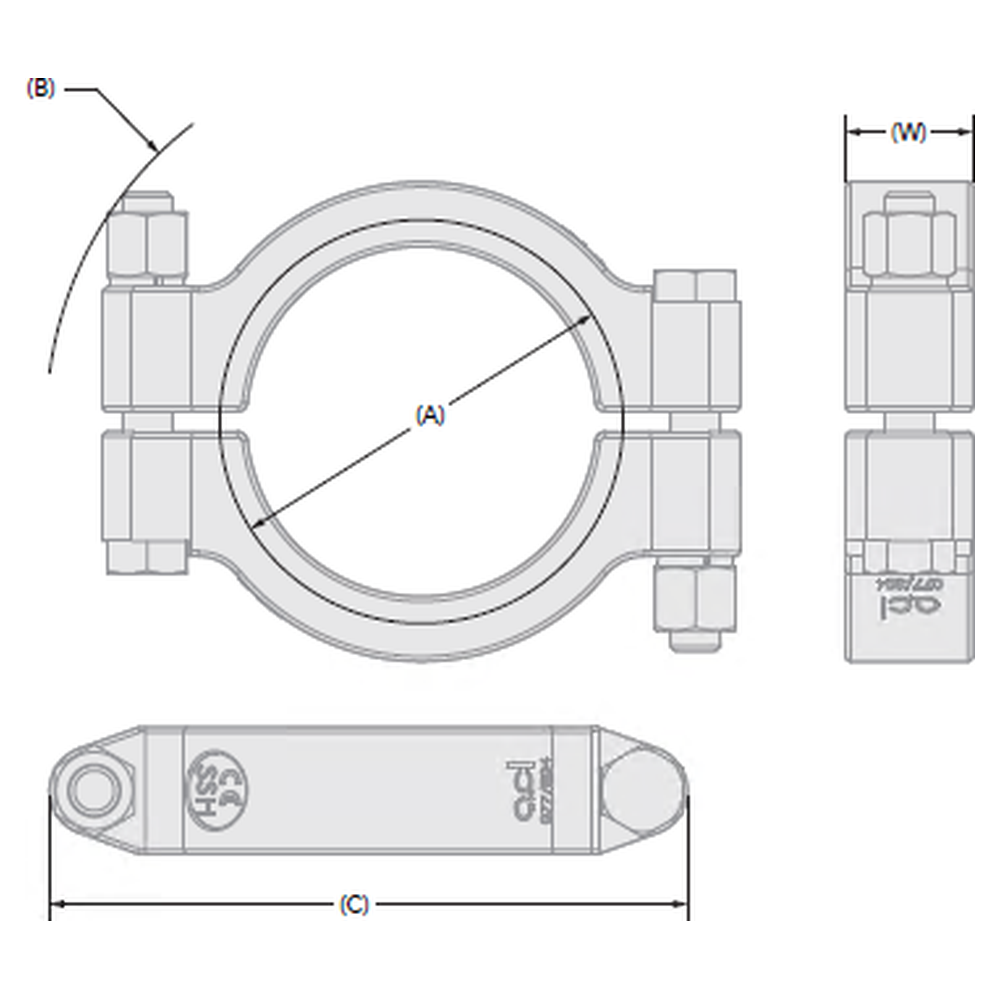
Dimensional drawing key: A flange diameter (ferrule face), B opening radius, C overall length, W band width.
The gasket, the sensitive link in the clamp fitting
The quality of a clamp connection depends on three elements: the gasket, the clamp and the alignment of the pipework.
The gasket provides sealing and at the same time absorbs the torsional loads transmitted by the pipework. This dual role is the weak point of the clamp fitting. A misaligned or stressed section makes the gasket work constantly, causing wear and then premature tearing.
Moving to high pressure amplifies the phenomenon: initial compression is higher, and a gasket already subjected to shear by misalignment is crushed asymmetrically. The clamp does not correct misalignment; it distributes the load. The gasket material, EPDM, silicone, FKM or PTFE, is chosen based on chemical compatibility and operating temperature.
The different types of clamps
The SSH covers high-pressure connections. The other versions address different constraints.
| Version | Closure | Use |
| Reinforced double-screw SSH | 2 screws, 2 segments | High pressure, from 75 to 20 bar depending on diameter |
| SH single-screw, double hinge | 1 screw, 2 axes | Standard connections from 50 to 10 bar, frequent dismantling |
| Double hex nut | 1 screw, 2 nuts | Controlled and traceable tightening torque |
| Anti-opening safety | Shouldered eye bolt and grooved housing | Points where accidental opening under pressure must be prevented |
| Three segments | 3 segments | Large diameters, load distribution over three faces |
| Polymer, single-use | Quick closure | Bags, filters and disposable lines |