
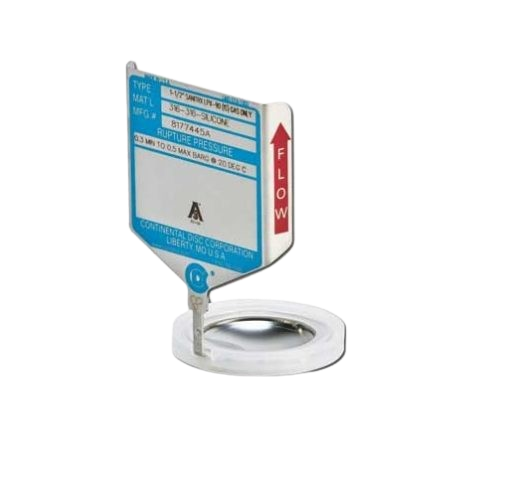
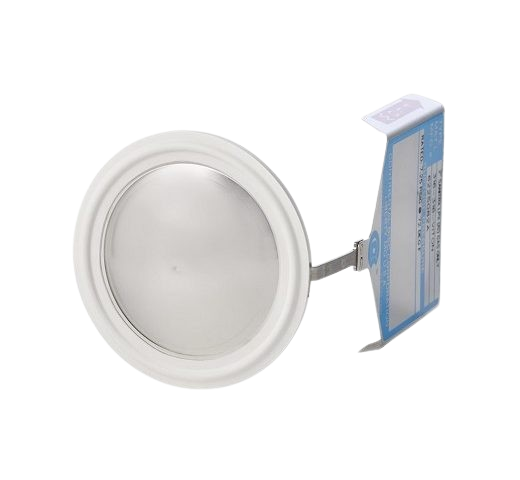
Sanitrx-LPX Low-Pressure Sanitary Rupture Disc
How do you protect a fermenter, filter or sanitary tank rated below 0.7 bar with a true reverse-acting disc, without going back to a flat membrane that fatigues at the first vacuum cycle?
Continental Disc®’s SANITRX LPX disc covers exactly the range that the SANITRX HPX® does not reach:
burst pressure from 0.40 to 0.689 barg, DN 40 to DN 80, polished 316L stainless steel Ra 0.5 µm, direct mounting between sanitary clamp ferrules.
SANITRX LPX page on the Continental Disc Corporation website
SANITRX LPX, reverse-acting low-pressure sanitary rupture disc
Scored semi-circular reverse-acting disc, burst pressure 0.40 to 0.689 barg, DN 40 to DN 80, gas service, SF1 finish Ra 0.5 µm, ASME BPE, USP Class VI, 3-A
Reverse-acting sanitary rupture disc designed for pharmaceutical, biotechnology and food processes whose protection pressure is below the SANITRX HPX® threshold (0.689 barg, 10 psig).
316 / 316L stainless steel dome, precision semi-circular score machined on the vent side: the process face remains smooth, with no groove to clean.
Non-fragmenting design.
Minimum service life of 1,000 cycles from full vacuum to maximum operating pressure.
Internal surfaces and ferrules with SF1 finish to ASME BPE, i.e. Ra ≤ 0.5 µm (20 micro-inches), electropolishing as an option.
Integrated gasket certified USP Class VI with full material traceability.
Components free of polishing compound, release agent and animal-derived ingredients. Gas service only.
Flow resistance coefficient KRG = 1.13, National Board certified.
What it is for
Below 0.7 bar, choosing a sanitary rupture disc becomes more complicated. A forward-acting disc set at 0.4 bar works under permanent tension at 90% of its burst pressure, and each return to vacuum after a SIP cycle flexes it in the wrong direction.
The known result: fatigue, burst pressure drift, premature bursting, batch shutdown.
The SANITRX LPX applies the reverse-acting principle to very low pressures: the dome works in compression, the process pressure acts on the convex face, and full vacuum does not damage it.
A tank that goes from vacuum to pressure several times a day keeps a stable disc for at least 1,000 cycles.
Typical applications: sterilising filters and vent filters, autoclaves, bioreactors and fermenters, process tanks, storage and transport tanks, WFI tanks, heat exchangers, clean steam piping, CIP/SIP skids, freeze-dryers, mixers, dryers and granulators.
Anywhere the design pressure of the protected equipment is low and the product-contact surface must remain ASME BPE compliant.
Diameters 1½″, 2″ and 3″ (DN 40, DN 50, DN 80). Burst pressure 0.40 to 0.689 barg (5.8 to 10 psig) at 22°C. A permanently attached three-dimensional flow-direction tag protrudes from the line: installation direction and burst data can be read without dismantling. Installing a reverse-acting disc upside down reduces its burst pressure unpredictably: the tag is there to make sure that does not happen.
The disc is mounted directly between two standard sanitary clamp ferrules, between NovAseptic® NA-CONNECT® flanges or in dedicated SANITRX® fittings. No disc holder to machine, no additional retention.
Characteristics
| Characteristic | Value |
| Type | Reverse-acting disc, semi-circular score on the vent side, non-fragmenting |
| Diameters | 1½″, 2″, 3″ (DN 40, DN 50, DN 80) |
| Burst pressure range | 0.40 to 0.689 barg (5.8 to 10 psig) at 22°C, identical across all three diameters |
| Burst tolerance | ±0.138 barg (±2 psig) above 0.552 barg (8 psig); ±25% at 0.552 barg and below |
| Operating ratio | Maximum 90% of marked burst pressure, minus the tolerance |
| Vacuum and cycling resistance | Full vacuum permissible, minimum 1,000 cycles from vacuum to maximum operating pressure |
| Fluid | Gas only |
| Disc and ferrule material | 316 / 316L stainless steel (other materials on request) |
| Connection | Between standard sanitary clamp ferrules, NovAseptic® NA-CONNECT® flanges or SANITRX® fittings |
| Integrated gasket | Peroxide silicone, platinum silicone, white or black Viton®, white or black EPDM, PTFE, stainless-steel-reinforced PTFE. USP Class VI and FDA certified |
| Temperature range (limited by the gasket) | Peroxide silicone -62 / +232°C; platinum silicone -62 / +177°C; Viton® -29 / +204°C; EPDM -48 / +135 to 149°C; PTFE -40 / +232°C; stainless-steel-reinforced PTFE -29 / +232°C |
| Steam sterilisation | SIP up to 130°C |
| CIP / SIP | Clean-in-place and sterilise-in-place, score on the vent side |
| Standard surface finish | SF1 ASME BPE: Ra ≤ 0.5 µm (20 micro-inches), internal surfaces and ferrules |
| Electropolished finish | Optional |
| Coating | Optional fluoropolymer, against corrosion |
| KRG factor (gas) | 1.13, National Board certified |
| Labelling | Permanently attached 3D flow-direction tag, burst data visible in line |
| Compliance | ASME BPE, USP Class VI, 3-A, traceable materials, free of animal derivatives |
| Certifications on request | ASME Section VIII Division 1, ASME (UD) stamp |
| Burst detection | Compatible with B.D.I.® (Burst Disc Indicator) alarm system |
Options
Electropolished finish on process-exposed surfaces.
Fluoropolymer coating for corrosive environments.
ASME Section VIII Division 1 (UD) stamp on request, to be specified when ordering.
Choice of integrated gasket from six materials according to the fluid, the SIP temperature and the regulatory file.
B.D.I.® burst sensor for alarm reporting to the control room or PLC.
Frequently asked questions
SANITRX LPX or SANITRX HPX®: where is the boundary?
At 0.689 barg, i.e. 10 psig. The SANITRX HPX® starts at 0.689 barg and goes up to 17.2 barg, in DN 25 to DN 80, for gas and liquid alike. The SANITRX LPX takes over from 0.40 to 0.689 barg, in DN 40 to DN 80, for gas only. A burst pressure below 0.689 barg on a sanitary tank means an LPX. Above it, an HPX®. No grey area.
Why a ±25% tolerance below 0.552 barg?
Because at these pressures, the absolute tolerance becomes a physical limit. ±25% on a burst pressure of 0.40 barg represents ±0.10 barg, an order of magnitude comparable to the ±0.138 barg applied above 0.552 barg. The practical consequence for sizing: the maximum operating pressure is calculated at 90% of the burst pressure minus the tolerance. For a disc rated at 0.40 barg, this gives 0.90 x 0.30 = 0.27 barg maximum operating pressure. It is this figure that must appear in the design calculation, not the burst pressure.
Gas service only: is that a real limitation?
Yes. The SANITRX LPX protects gas headspaces: fermenters, vent filters, tanks under nitrogen or sterile air, autoclave chambers. If overpressure can come from the liquid, through uncontrolled filling or water hammer, a liquid-qualified disc is required, i.e. a SANITRX HPX® or an IntegrX-HPX™ with a suitable burst pressure.
Which gasket should be chosen for SIP at 121°C or 130°C?
Platinum silicone (up to 177°C) for most biotech processes, with its reduced extractables. EPDM (135 to 149°C) when chemical compatibility with alkaline CIP is the priority. PTFE or stainless-steel-reinforced PTFE (232°C) as soon as thermal cycling is intense or the fluid is aggressive. All materials offered are USP Class VI certified, with batch traceability.
Is the disc subject to the PED 2014/68/EU?
The PED only applies to equipment whose maximum allowable pressure PS exceeds 0.5 bar. Part of the SANITRX LPX range lies below this threshold. The regulatory status therefore depends on the burst pressure and the protected equipment: to be validated case by case with your notified body. Tubes Technologies will provide you with the manufacturer data required for the file.
How can you tell the disc has burst without opening the line?
With Continental Disc®’s B.D.I.® alarm system, compatible with the SANITRX LPX. The sensor detects the opening of the disc and sends a signal to the PLC. On a fermentation tank of several thousand litres, an undetected burst means an undetected loss of sterility. The sensor costs less than a batch.