
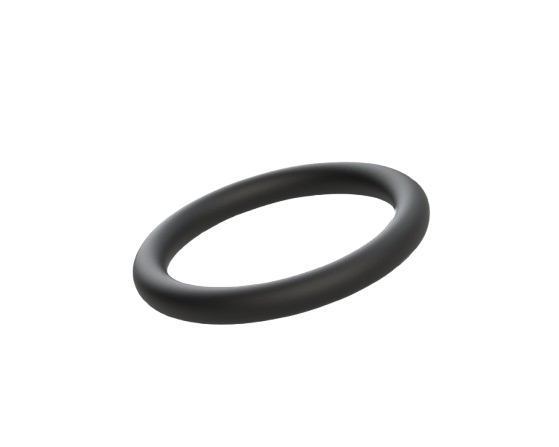
Aseptic O-Ring for DIN 11864 Form A Fittings FDA USP Class VI
On an aseptic fitting, sealing is not provided by the clamp or the flange but by the O-ring housed in its groove. Unlike the flat clamp gasket, the O-ring is contained in a standardised seat that compresses it without allowing it to creep into the flow path or subjecting it to mechanical stress. This eliminates the retention zone and meets aseptic requirements while ensuring maximum gasket service life.
Four materials are available from stock, each for a specific field of application: EPDM for aqueous media and steam, FKM for oils and solvents, PTFE for maximum chemical inertness, and FEP-encapsulated FKM for chemical resistance with the flexibility of an elastomer. Machining or moulding on request for other needs.
DIN 11864 designations summary
O-ring for DIN 11864 fittings, form A
Aseptic O-ring with no retention zone, EPDM, FKM, PTFE and FEP-encapsulated FKM
Aseptic O-ring for DIN 11864 form A fittings. A sealing element with no dead zone, housed in a standardised groove that compresses it without creep into the flow path. Installed according to DIN 11864-1 v.11.2008, dimensional tolerances to ISO 3601-1. Four materials in stock: EPDM, FKM, PTFE, FEP-encapsulated FKM. FDA, EC 1935/2004 and at least USP Class VI approvals. Machining or moulding on request.
Four materials, four fields of application
The O-ring body is chosen based on fluid and temperature, as for any gasket. The difference lies in the shape, contained in a groove, but the material logic remains the same as for clamp gaskets. The four materials cover most aseptic processes.
| Material | Field of application | What it offers |
| EPDM | Water, steam, aqueous CIP and SIP | Flexible, economical, the default choice for aqueous circuits and clean-in-place |
| FKM | Oils, solvents, acids, high temperature | Resists where EPDM swells, high thermal resistance, low gas permeability |
| PTFE | Aggressive chemicals, maximum inertness | Virtually total chemical inertness, compatible with almost all pharmaceutical products |
| FEP-encapsulated FKM | Aggressive media with a flexibility requirement | Inert FEP encapsulation on a flexible FKM core. If the encapsulation is punctured, the FKM core continues to resist chemicals |
FEP-encapsulated FKM deserves a mention. It combines the chemical inertness of the FEP fluoropolymer on the surface with the resilience of an FKM core, giving greater flexibility than solid PTFE. It is the material for hostile chemical media where a bare elastomer O-ring would not hold and where solid PTFE would lack the flexibility to seal.
Aseptic with no dead zone
The DIN 11864 standard defines hygienic and aseptic fittings designed to have no retention zone at the seal. The O-ring is at its heart: housed in a controlled groove and compressed in a controlled manner, it cannot creep into the flow path or create a crevice.
This is the fundamental difference from a flat clamp gasket, whose manual centring and free compression always leave a risk of retention. In an aseptic process, the absence of dead zones is a design requirement, not a luxury. The DIN 11864 fitting also incorporates a compression limiter that minimises the risk of the gasket deforming towards the inside of the tube.
Form A designates the standardised groove geometry for O-rings, the most widespread of the DIN 11864 connections. Sealing repeatability is ensured from one installation to the next, as the groove sets the compression.
Standard and dimensions
The gasket is installed according to DIN 11864-1 v.11.2008. Its dimensions comply with the ISO 3601-1 tolerance standard. The inside diameter and cross-section of the O-ring are defined by the fitting standard and the tube DN.
DIN 11864 fittings exist in three connection forms, threaded, flanged and clamp, all built around the same form A O-ring groove. The correspondence between tube DN, gasket diameter and cross-section is given in the dimensional table, available for download.
Approvals
Aseptic O-rings carry the same approvals as the supplier’s aseptic range: FDA, Regulation (EC) 1935/2004 on food contact materials, and at least USP Class VI. These approvals cover pharmaceutical, biological, chemical and food use.
The material selected must carry the corresponding certificate for the batch delivered. Compliance requirements are assessed material by material and according to the process.
The gasket: the sensitive link in the aseptic fitting
On an aseptic fitting, as on a clamp fitting, the sealing and cleanliness of the process depend on the gasket. A damaged, poorly seated O-ring, or one made of unsuitable material, compromises both sealing and asepsis.
The O-ring is the consumable part of the connection: it is replaced, not salvaged. A gasket that is marked, nicked or outside its temperature range must be changed. The standardised groove limits the risk of incorrect installation, but the choice of material remains the responsibility of the process designer.
Applications
Pharmaceutical, biotechnology, chemical and food processing industries, on aseptic fittings requiring the absence of retention zones. Sterile loops, SIP processes, low dead-volume lines, process points where gasket control takes priority over ease of dismantling.
On frequently dismantled connections where strict asepsis is not required, a flat clamp gasket remains simpler and more economical. The DIN 11864 O-ring is justified when the design requires zero dead zones.
Characteristics
| Characteristic | Value |
| Type | Aseptic O-ring, DIN 11864 form A fittings |
| Installation standard | DIN 11864-1 v.11.2008 |
| Dimensional tolerances | ISO 3601-1 |
| Materials in stock | EPDM, FKM, PTFE, FEP-encapsulated FKM |
| Made to order | Custom machining or moulding |
| Approvals | FDA, EC 1935/2004, at least USP Class VI |
| Connection forms | Threaded, flanged, clamp |
| Function | Aseptic sealing with no retention zone |
Frequently asked questions
Which material should I choose?
EPDM for water, steam and clean-in-place. FKM as soon as oils, solvents or high temperature are involved. PTFE for maximum chemical inertness. FEP-encapsulated FKM for aggressive media requiring both the chemical resistance of a fluoropolymer and the flexibility of an elastomer. The choice depends on the fluid and operating temperature.
What does FEP encapsulation add to FKM?
FEP encapsulation gives the O-ring the chemical inertness of a fluoropolymer on the surface, while retaining the flexibility of the FKM core. If the encapsulation is punctured, the FKM core continues to resist a wide range of chemicals. It is a compromise between solid PTFE, highly inert but rigid, and a bare elastomer, flexible but less chemically resistant.
Why an O-ring rather than a flat clamp gasket?
Because the O-ring is housed in a groove that contains it, with no possible creep into the flow path and no crevice. The flat clamp gasket, centred by hand and freely compressed, always leaves a risk of retention. In an aseptic process, the absence of dead zones is a regulatory requirement, not a luxury.
What if the required material is not in stock?
The four materials, EPDM, FKM, PTFE and FEP-encapsulated FKM, are kept in stock. For a specific need, a non-standard size or another material, the O-ring is machined or moulded on request.
Form A: what does it mean?
Form A is the DIN 11864 standardised groove geometry for O-rings, the most common one. It sets the cross-section and compression of the O-ring, which guarantees sealing repeatability from one installation to the next.