
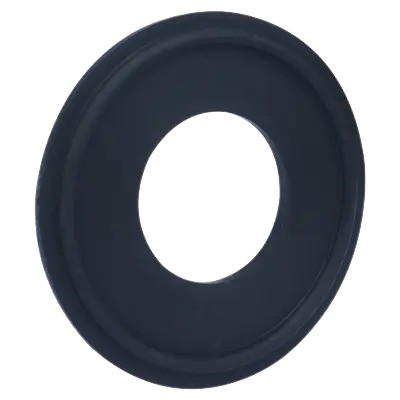


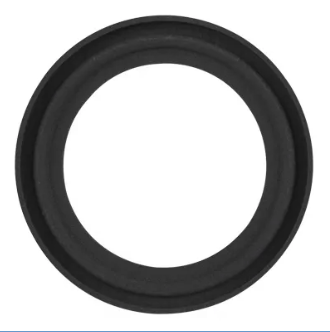


EPDM FDA USP Class VI Clamp Gasket
RubberFab materials and chemical compatibility guide
Tubes Technologies gasket selection guide
Rubberfab references, Type I gasket without lip
Rubberfab references, Type II gasket with lip
Guidelines for sanitary gasket materials
On a tri-clamp connection, sealing is not provided by the clamp but by the gasket. The clamp sets the compression; the gasket turns it into a seal and absorbs the forces from the line. The choice of its material determines the allowable temperature, chemical compatibility and service life of the connection.
EPDM is the most widely used elastomer on water, low-pressure steam and cleaning circuits. Service range from -34 °C to +149 °C. It is not compatible with oils, greases or most solvents.
Peroxide-cured EPDM elastomer, -34 °C to +149 °C, without lip and with lip
Peroxide-cured EPDM clamp gasket, available without lip (Type I, known as Type B) and with centring lip (Type II, known as Type A). Service range from -34 °C to +149 °C, low-pressure steam permitted. Compliant with FDA CFR 177.2600 and 177.1550, USP Class VI, ADI-free, manufactured according to cGMP guidelines. Diameters from 1/2″ to 12″. Compatible with water, low-pressure steam, dilute acids and bases, aqueous CIP and SIP media.
Where EPDM is the right choice, and where it is not
EPDM withstands hot water, low-pressure steam, acidic or alkaline aqueous solutions, and most clean-in-place agents. This makes it the default gasket for purified water loops, WFI networks below 149 °C, and aqueous process lines in food processing and pharmaceuticals.
It does not withstand oils, animal or vegetable fats, hydrocarbons or non-polar solvents. In these fluids, EPDM swells, loses its compression and eventually leaks. The reflex of choosing EPDM because it is the cheapest and most readily available leads to repeated replacements as soon as there is fat in the line. This is where FKM or PTFE are required.
Steam is a special case. Peroxide-cured EPDM withstands low-pressure steam, but not continuous high-pressure saturated steam. On a line with intensive SIP, check the frequency and temperature of the cycles, and consider a PTFE-enveloped gasket if the cycles are severe.
Type I and Type II: the lip changes installation
Type I, or Type B, is a flat gasket without lip. It is centred by hand in the groove of the two ferrules. This is the most common and least expensive version.
Type II, or Type A, has a centring lip that fits into the inside diameter of the ferrule. The gasket positions itself, cannot shift while the clamp is being closed, and alignment of its inner face with the flow path is guaranteed. On lines where a shifted flat gasket creates retention, or on hard-to-reach overhead installations, the lip eliminates the risk of poor centring.
The choice between the two does not depend on the material, which is identical, but on the centring requirement at the installation point. Both versions cover the same temperature range and the same chemical compatibility.
Material properties
| Characteristic | Value |
| Elastomer | EPDM, peroxide-cured |
| Service temperature | -34 °C to +149 °C (-30 °F to 300 °F) |
| Steam | Low pressure only |
| Compatible | Water, LP steam, dilute acids and bases, aqueous CIP and SIP, ozone |
| Not compatible | Oils, fats, hydrocarbons, non-polar solvents |
| Compliance | FDA CFR 177.2600 and 177.1550, USP Class VI, ADI Free, cGMP |
| Versions | Type I without lip, Type II with centring lip |
The temperature range and chemical compatibilities come from the manufacturer’s data. Detailed fluid-by-fluid chemical information is provided in the materials guide and the compatibility sheet, available for download.
Dimensions
Standardised dimensions, common to all tri-clamp gasket materials. The gasket outside diameter corresponds to the ferrule face, the inside diameter to the flow path. A gasket whose inside diameter protrudes into the flow path creates retention; a gasket that is too small opens a crevice.
| Size | Gasket ID (mm) | Gasket OD (mm) | Ferrule flange A (mm) | Tube DN |
| 1″ | 22,9 / 0.900″ | 50,4 / 1.984″ | 50,5 | DN25 |
| 1 1/2″ | 35,6 / 1.400″ | 50,4 / 1.984″ | 50,5 | DN40 |
| 2″ | 48,3 / 1.900″ | 63,9 / 2.515″ | 64 | DN50 |
| 2 1/2″ | 61,0 / 2.400″ | 77,5 / 3.050″ | 77,5 | DN65 |
| 3″ | 73,7 / 2.900″ | 90,9 / 3.579″ | 91 | DN65 |
| 4″ | 98,3 / 3.869″ | 118,9 / 4.682″ | 119 | DN100 |
| 6″ | 147,8 / 5.817″ | 165,3 / 6.507″ | 167 | DN150 |
Millimetre conversions are for guidance only, based on the manufacturer’s dimensions in inches. The complete clamp, ferrule and tube correspondence table is available for download.
Compliance and validation
EPDM gaskets from 1″ to 4″ are FDA CFR 177.2600 and 177.1550 compliant, USP Class VI certified, ADI Free certified and manufactured according to cGMP guidelines. They are available in a metal-detectable, X-ray inspectable version for food processing lines subject to foreign-body detection.
The gasket: the sensitive link in the clamp fitting
The quality of a clamp connection depends on three elements: the gasket, the clamp and pipe alignment. The gasket provides the seal and at the same time absorbs the torsional forces transmitted by the line. This dual role is the weak point of the clamp fitting.
A misaligned or stressed section makes the gasket work constantly, causing wear and then premature tearing. Excessive tightening pushes the gasket into the flow path and creates a dead leg. Compression is achieved at the torque specified for the clamp, never by feel. The gasket is the consumable part of the connection: it is replaced, not salvaged.
EPDM compared with other materials
A gasket material is chosen based on temperature, fluid, dismantling frequency, regulatory requirements and cleaning method. EPDM covers aqueous circuits; here is what sets it apart from other materials and when to prefer an alternative.
| Material | What it offers | Its limitations |
| EPDM (and silicone) | Very flexible, seals even on irregular surfaces, easy to install, readily available, economical | Limited temperature resistance, sensitive to solvents and oxidising agents, does not withstand oils |
| FKM Viton | Resists solvents, oils and acids, withstands up to 204 °C, low gas permeability, ozone-resistant | Less effective with strong oxidisers, less flexible and therefore more demanding on surface finish and tightening, more expensive |
| Solid PTFE | Exceptional chemical and thermal resistance, compatible with a wide range of pharmaceutical products | Very rigid and therefore requires high tightening, possible creep, sealing sometimes difficult to guarantee |
| EPDM/PTFE enveloped | PTFE product face for chemical inertness, EPDM core for flexibility, good compromise between installation and performance | Possible creep if overtightened, EPDM core limited in temperature, can be replaced by an FKM core |
| Gylon 3504 | More flexible than solid PTFE, low tightening force, very good creep resistance, -260 to +268 °C, asbestos-free | Flat gasket without lip, care required during installation, blue colour |
| Tuf-Flex | PTFE filled with stainless steel beads, excellent crush resistance, custom-machined with or without lip | More expensive, compatibility to be checked with strong oxidisers |
Each material has a dedicated data sheet with its service ranges, compliance and detailed chemical compatibilities.
Frequently asked questions
EPDM or FKM?
EPDM for aqueous circuits, water, low-pressure steam and cleaning. FKM as soon as oils, fats, solvents or a temperature above 149 °C are involved. On a mixed line, the most aggressive fluid decides.
Does EPDM withstand steam?
Low-pressure steam, yes. High-pressure saturated steam in repeated cycles, not without verification. For intensive SIP, the severity of the cycles must be examined and a PTFE-enveloped gasket considered.
Type I or Type II?
Type I, without lip, for standard installation. Type II, with centring lip, when the gasket must position itself and not shift, particularly where access is difficult or at points where shifting creates retention. Same material, same range; only the centring differs.
Which thickness should I choose?
The standard thickness is suitable for almost all cases. A specific thickness question depends on the exact installation point and is handled case by case.
How do I choose the size?
On the outside diameter of the ferrule, like the clamp. The gasket inside diameter must be flush with the flow path without protruding. The correspondence table gives the equivalence between size, ferrule and tube.