
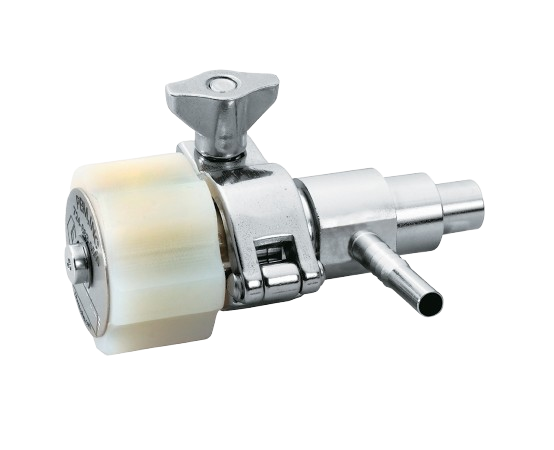
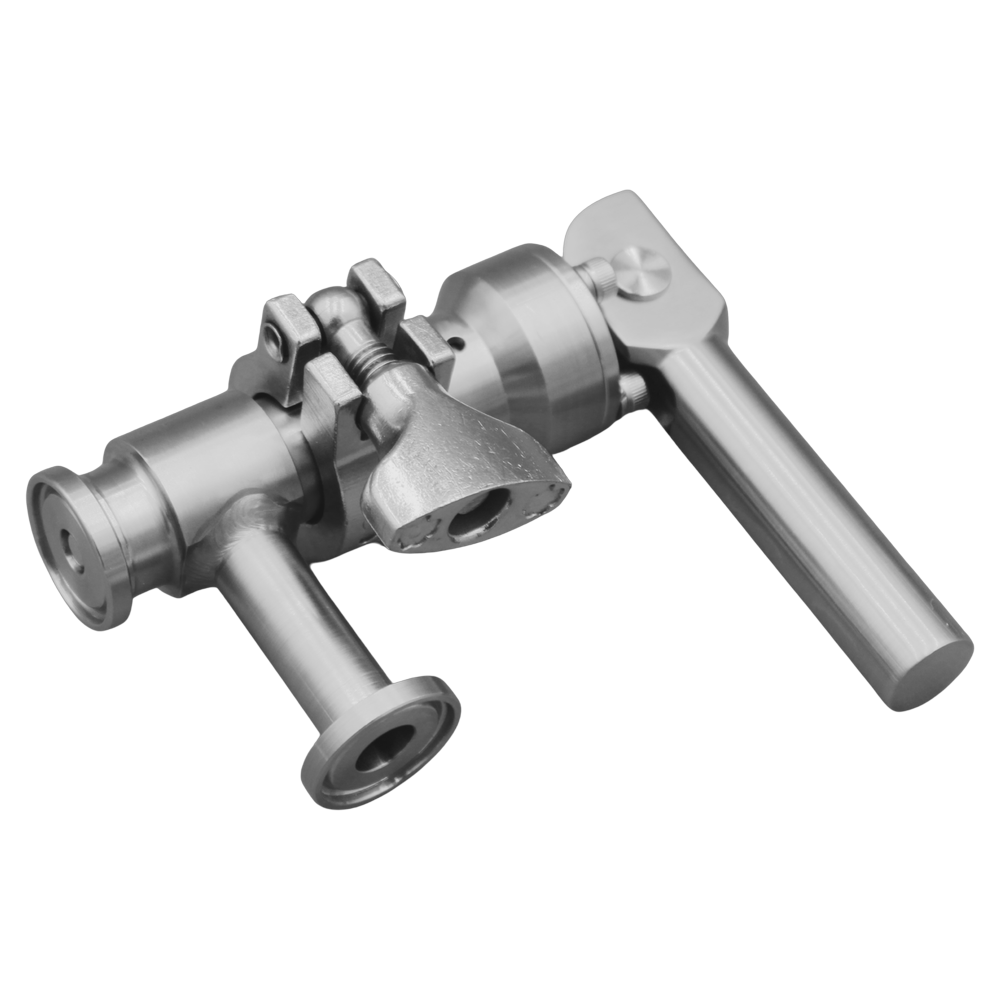
IMI PBM Sampling Valve
Sanitary rising stem sampling valve, IMI PBM range
IMI PBM Valve Solutions – Sampling valve for quality control and process monitoring
The IMI PBM Rising Stem Sampling Valve range is designed for a single purpose: precise, repeatable process sampling, without contaminating the remaining fluid and without disturbing the main line.
Unlike a ball valve used for sampling (direct fluid path, all-or-nothing flow, difficult to control at small openings), the rising stem valve offers gradual flow control over more than one turn, making sampling controllable from drop-by-drop to a continuous stream.
Used in pharmaceuticals, biotechnology, fine chemicals, brewing, winemaking, dairy and food processing, at quality control points, bacteriological sampling, fermentation monitoring and sterility testing.
Principle and benefits in sampling
On a ball valve used for sampling, flow goes from zero to maximum over a quarter turn, making it impossible to slowly fill a sterile vial or finely adjust a sample volume.
In addition, the ball cavity retains a residual volume between two samples, with a risk of cross-contamination and distorted analyses.
The rising stem valve progressively raises a cone-shaped plug by turning the handwheel: flow increases linearly over about 1.25 turns from the closed position.
The total Cv at full opening remains moderate (about 1.0 gpm), calibrated for sampling rather than transfer.
The body geometry eliminates retention zones between two samples and prevents carry-over from one batch to the next.
Available configurations
Three main configurations, selected according to connection geometry and accessibility:
| Configuration | Body | Typical application |
| Standard 2-piece | Adjustable body | Sampling on the main line, swivelling outlet |
| Short 1-piece | Compact body | Confined space, direct mounting on tank |
| Inline 1-piece | Straight-through body | Continuous integration on the line, without elbow |
Sample outlet can be swivelled and angled on 2-piece versions, to adapt the flow to the vial or collection tube without modifying the pipework.
Body and wetted-part materials
316L stainless steel as standard, forged or machined from solid depending on the version.
Alternatives available in Hastelloy® C-276 and C-22 for corrosive media.
Composition and traceability compliant with ASME BPE. 3.1 material certificate supplied for all wetted parts.
Seats, seals and sealing
Standard TFM™ (modified PTFE) seats for plug/body sealing.
Stem O-ring in USP Class VI FKM (Viton) as standard, EPDM alternative available for processes incompatible with FKM (steam, certain amines).
Bubble-tight sealing in the closed position, suited to maintaining process sterility between two samples.
Number of moving parts minimised to reduce retention and potential contamination points.
Hygienic design
Continuous, drainable fluid path, with no dead zone between the plug and the main line.
SIP and autoclave compatible, allowing complete sterilisation of the valve between two sampling campaigns.
3-A certification available for dairy and beverage applications, where compliance with 3-A Sanitary Standards is mandatory.
Surface finish
| Finish | Internal Ra | Target applications |
| Standard mechanical | ≤ 0.81 µm (32 µin) | Food processing, brewing, fine chemicals |
| Fine mechanical | ≤ 0.51 µm (20 µin) | Pharma, biotech |
| Electropolished | ≤ 0.38 µm (15 µin) | High-purity pharma, sterile WFI sampling |
Surface treatments performed without animal-derived ingredients (ADI-free).
Dimensions and connections
Standard inlet diameter 1/4″ (6.35 mm), calibrated for sampling flow.
Process-side connections available as weld or 1/2″ hygienic clamp (Tri-Clamp).
Compatible with ASME BPE, DIN 11864 and SMS dimensional standards.
Sample outlet with sanitary thread, flanged nozzle or hose barb for vial connection depending on the version.
Operating range
Operating pressure compatible with typical sampling conditions on WFI and clean steam loops; maximum pressure depending on series and seat material, specified in the technical bulletin.
Full vacuum rated as standard.
Temperature up to 175 °C with EPDM seals, suitable for sampling on 80 °C WFI loops and 121 °C SIP cycles.
Autoclavable with partial disassembly according to the manufacturer’s protocol.
Actuation
Manual operation by control handwheel, multi-turn rotation for fine flow control.
Locking in the closed position available to prevent accidental opening.
Automated version with linear actuator available on request for sequenced sampling stations.
Traceability and packaging
Each valve is supplied with a 3.1 material certificate according to EN 10204 for all wetted parts (CMTR), a USP Class VI declaration of conformity for elastomers, an FDA statement for product-contact materials and a 3-A certificate when that version is specified.
Laser marking on the body: reference, size, material, serial number.
Individually packed in a polyethylene sleeve, with capped ends.