
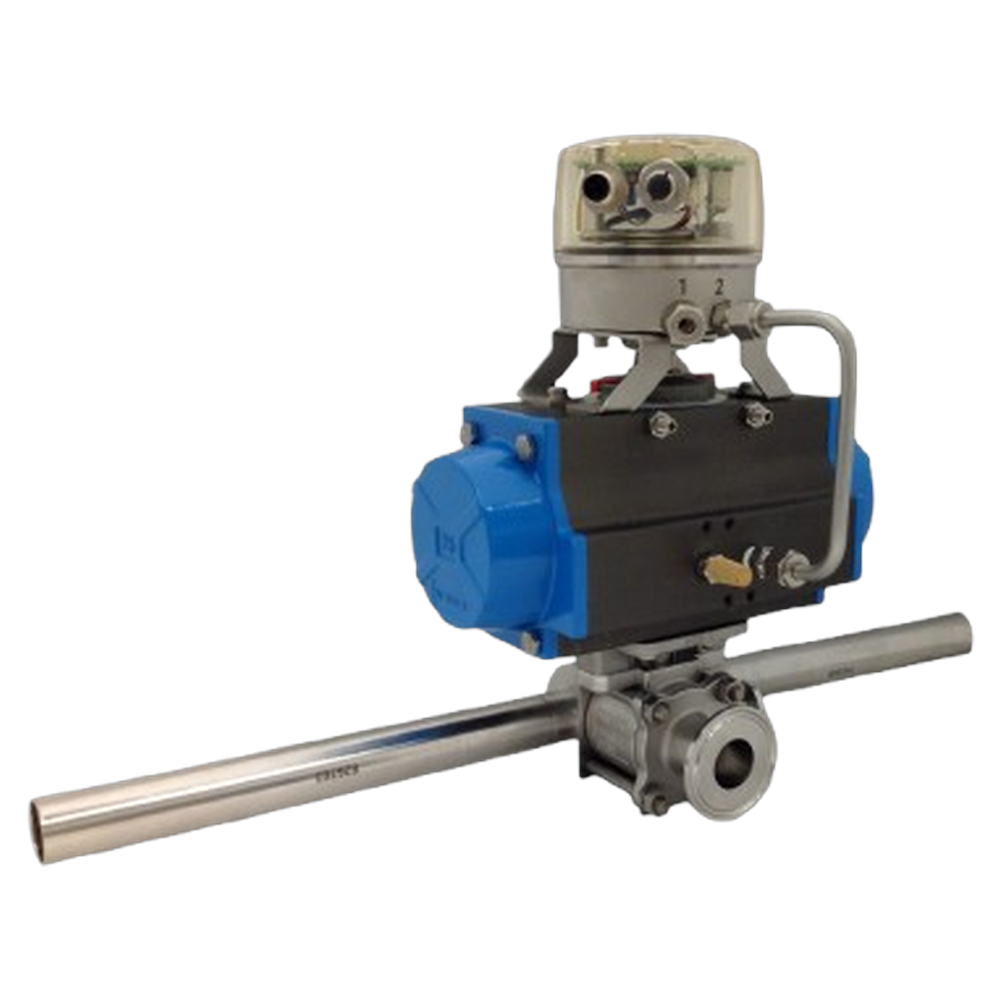
IMI PBM Zero Dead Leg Ball Valve
Sanitary Zero Dead Leg ball valve, IMI PBM Z-Ball® range
IMI PBM Valve Solutions – Zero dead leg branch valve for WFI, PW and clean steam loops
The IMI PBM Z-Ball® range is designed for a specific point in pharmaceutical loops: the point-of-use branch on a WFI, PW or clean steam loop.
In a conventional installation, this branch combines a diaphragm valve at the point of use and a ball valve on the main loop, separated by a length of pipework.
This section is the dead leg: the loop fluid flows past it without sweeping it, and a column stagnates between the two valves. ASME BPE-2016 sets the limit at 2×D (twice the branch diameter); beyond that, the section becomes a contamination point and a reason for rejection during qualification.
The Z-Ball® combines both functions in a single compact body. The main loop passes through the valve, the point-of-use branch exits perpendicularly, and the internal geometry eliminates the dead section by design.
Used in pharmaceuticals, biotechnology and aseptic manufacturing, on WFI loops, PW networks, clean steam distribution and sterile barriers with multiple points of use.
Principle and benefits on point-of-use loops
A WFI loop typically serves 15 to 40 points of use on the same circuit. Each conventional branch generates a dead leg of several cm of stagnant tube, where the temperature can drop and rouging starts faster than elsewhere on the loop.
On a loop with 50 points of use, this represents as many zones to monitor during qualification, to passivate and to requalify periodically.
The Z-Ball® reduces this dead leg to measurable zero. The ball, perpendicular to the main flow, isolates or opens the point of use without introducing a stagnant section. The loop continues to sweep the valve body with each circulation, preventing thermal stratification and the onset of rouging at that location.
It replaces the diaphragm + ball + intermediate tube combination with a single component, reducing the number of orbital welds and the total installation cost.
Body and wetted-part materials
Low-ferrite 316L stainless steel as standard, forged.
Alternatives available in AL-6XN® (UNS N08367) for chloride-bearing fluids and in Hastelloy® C-22 (UNS N06022) for extremely corrosive media.
Composition and traceability compliant with ASME BPE. 3.1 material certificate supplied for all wetted parts.
Seats, seals and sealing
Standard V-TEF™ (modified PTFE) seats. FKM and EPDM alternatives available depending on chemical compatibility and temperature.
USP Class VI elastomers, FDA-compliant materials.
Bidirectional bubble-tight sealing upstream and downstream at the point of use, independent of circulation in the main loop.
Full vacuum rated as standard, a critical condition for post-SIP cooling phases.
Adjust-O-Seal® technology
Progressive tightening of the seats against the ball by adjusting the body bolts, in-line, without dismantling or process interruption.
Compensates for normal seat wear over cycles.
On a WFI loop operating 24/7 at 80 °C with a point of use cycled several times a day, this compensation avoids premature valve replacement and extends service life by several years.
Hygienic design and drainage
Body fully drainable in both open and closed positions, with no residual accumulation zone.
Continuous fluid path on the main loop, regardless of the ball position on the point-of-use side.
Optional purge port integrated into the body for condensate drainage in clean steam service or for zeroing between batches.
Surface treatments performed without animal-derived ingredients (ADI-free).
Clean steam service configuration
During clean steam header sterilisation, the Z-Ball® is opened to introduce steam into the process loop.
In the closed position, the integrated purge port drains condensate to a steam trap, preventing the build-up of condensed water that would compromise sterility at the next opening and create a cold spot.
This configuration replaces the traditional “loop valve + steam trap + return” assembly with a single component.
Surface finish
| Finish | Internal Ra | Target applications |
| Fine mechanical | ≤ 0.76 µm (30 µin) | Standard pharma, biotech |
| High-purity mechanical | ≤ 0.51 µm (20 µin) | High-purity pharma, WFI |
| Electropolished | ≤ 0.38 µm (15 µin) | High-purity pharma, clean steam, critical points of use |
Dimensions and connections
Sizes available from 1/2″ to 4″ (DN 15 to DN 100) on the main loop, branch port sized from 1/2″ to 2″ according to point-of-use flow.
Available connections: hygienic clamp (Tri-Clamp), extended tube ends for orbital welding, sanitary thread, flanges to specification.
Compatible with ASME BPE, DIN 11864 and SMS dimensional standards.
Operating range
Operating pressure up to 62.1 bar (900 psig) depending on seat material.
Temperature up to 232 °C with V-TEF™ seats, reduced ranges with FKM or EPDM seals depending on compatibility.
SIP compatible under repeated cycling (typically several cycles per day at a sterile point of use), subject to appropriate elastomer selection.
Actuation
Manual operation by lockable handle or automation.
Integrated Direct Mount Actuation interface on the stem axis, precise alignment with pneumatic or electric actuator and extended cycle life.
Network automation available as an option (DeviceNet and equivalents) for integration on multi-point automated skids.
Single-acting spring-return actuators (fail-safe close) available to guarantee closure of the point of use in the event of compressed air loss.
Traceability and packaging
Each valve is supplied with a 3.1 material certificate according to EN 10204 for all wetted parts (CMTR), a USP Class VI declaration of conformity for elastomers and an FDA statement for product-contact materials.
Laser marking on the body: reference, size, material, serial number, main loop flow direction.
Individually packed in a polyethylene sleeve, with capped ends.