
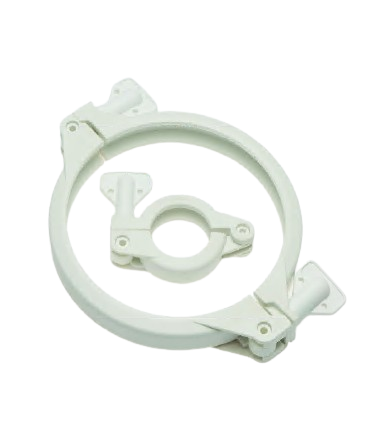
Nylon Clamp
A clamp consists of two half-shells joined by a hinge and closed by a tightening mechanism. On a tri-clamp connection, sealing is achieved by compressing the gasket between the two ferrule faces. The clamp holds this compression and determines how it is distributed around the gasket circumference.
This version is made entirely of polyamide, bolt and nut included. No metal parts. Tightening torque is capped at 2 Nm and the allowable pressure ranges from 10 bar at 1/2″ to 2 bar at 8″, at 20 °C
Advanced Coupling Clamp Specification
All-polyamide, hand-tightened, 1/2″ to 8″, DN8 to DN200
The Nylon clamp is a polyamide clamp with bolt and wing nut in the same material. Eight sizes from 1/2″ to 8″, i.e. DN8 to DN200, compatible with DIN 32676, ISO 2852 and ASME BPE ferrules. Maximum tightening torque of 2 Nm. Allowable pressure from 10 bar at 1/2″ to 2 bar at 8″, at 20 °C. Single hinge up to 4″, double bolt above.
2 Nm, and not one more
This is the value that governs the entire use of this clamp. Two newton-metres, i.e. a third of what is applied on a steel clamp with a wing nut, which is tightened to between 5 and 7 Nm.
Two newton-metres is not much. It is a firm tightening between thumb and forefinger, not a forceful twist of the wrist. An operator used to steel will exceed the value without realising it, and the polyamide thread will strip at the second or third reassembly, sometimes at the first.
The practical consequence is direct: this clamp is not put into service without written instructions and a demonstration. At a station where steel and nylon clamps alternate, the risk of error is constant. Many installations distinguish them by a colour code or reserve them for dedicated areas.
What polyamide brings
No metal parts in the assembly. This is the only valid reason to choose this clamp, and it is enough in several specific situations.
On food processing lines equipped with metal detectors or X-ray inspection, a steel clamp dropped into a hopper triggers a shutdown and the rejection of the batch. A polyamide clamp is not detected, which shifts the problem rather than solving it, but it does not contaminate with metal particles in the event of an impact either.
In imaging and metrology, polyamide is non-magnetic and transparent to fields. On test benches and pilot installations close to sensitive equipment, it is sometimes the only option.
The clamp is electrically insulating. It can be used to break continuity between two piping sections, which is of interest for cathodically protected assemblies and instrumentation loops where a stray ground distorts the measurement.
In severe chlorinated atmospheres, seawater washdown, brine, permanent salt spray, polyamide suffers neither crevice corrosion nor pitting, where even 316L eventually shows marks. Nor does it scratch the ferrule faces, being softer than stainless steel.
Then there is the weight. At 8″, the difference compared with a steel clamp of the same diameter is felt at arm’s length, on a rack mounted at height.
What polyamide demands
Nylon creeps. Under sustained load, the material slowly deforms and the tightening preload decreases. A connection tightened to the specified torque and then left in service for several months no longer has the same gasket compression. Periodic checking of tightening is part of the operating procedure; it is not optional.
Polyamide absorbs moisture. Depending on the grade, several percent of its mass, which changes its dimensions and mechanical properties. At a station subject to constant washdown, the clamp does not behave as it did straight out of the box.
The stated pressure is at 20 °C. No value is published above that, and the strength of a polyamide drops rapidly with temperature. In steam, in SIP, on any hot line, this version has no place.
Finally, ultraviolet radiation degrades the material.
Pressure rating
The maximum allowable pressure depends on the diameter and is given at 20 °C. It applies to the clamp alone.
| Diameter | DN equivalent | Flange A (mm) | MAWP at 20 °C |
| 1/2″ to 3/4″ | DN6 to DN10 | 25,4 | 10 bar |
| 1″ to 1 1/2″ | DN25 to DN40 | 50,5 | 10 bar |
| 2″ | DN50 | 64 | 8 bar |
| 2 1/2″ | DN50 (ISO) | 77,5 | 8 bar |
| 3 1/2″ | DN80 | 106 | 8 bar |
| 4″ | DN100 (DIN) | 119 | 6 bar |
| 6″ | DN150 | 167 | 3.5 bar |
| 8″ | DN200 | 217,4 | 2 bar |
For reference, the lightest steel clamp in the range withstands 25 bar at 1/2″ and 17 bar at 4″. The polyamide clamp delivers 10 and 6 respectively. At 8″, the 2 bar allowable limits use to drains, vents and gravity transfers.
The allowable pressure of the complete assembly depends on the gasket, its material and the operating temperature. The values in the table are the mechanical limit of the clamp, not that of the connection.
Construction
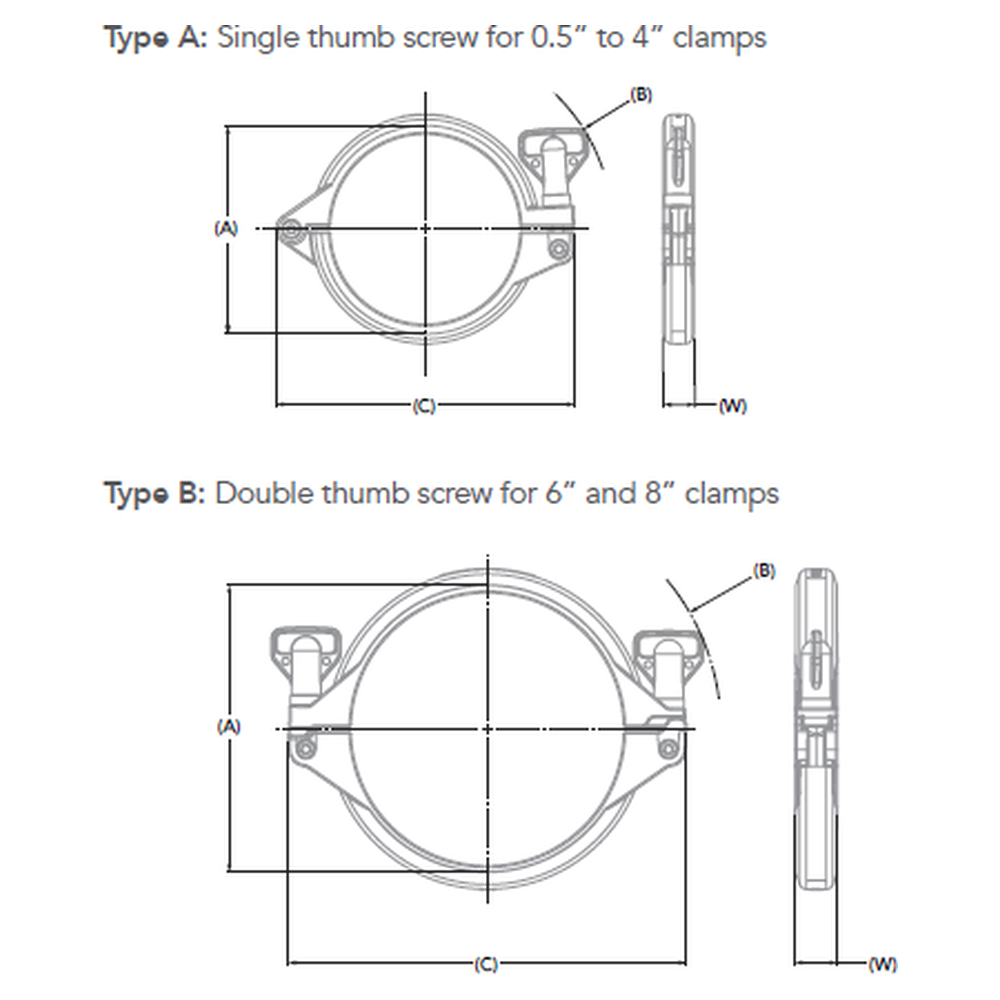
Single hinge, one bolt and one wing nut up to 4″. From 6″, two bolts to distribute the load over a band that cannot be thickened indefinitely without becoming impossible to handle.
Band width of 18 mm up to 4″, 24 mm at 6″ and 8″. Overall length from 60 mm to 271 mm depending on size.
Standards compatibility
The clamp is defined by the outside diameter of the ferrule face, not by the tube DN. It applies to ferrules made to DIN 32676 series A, B and C, ISO 2852 and ASME BPE, provided the flange diameter matches.
The range has gaps. It goes directly from the 77.5 mm flange to the 106 mm flange, without the 91 mm that corresponds to 3″ and DN65. The 130, 144.4, 155 and 183 mm flanges are also missing. Availability should be checked before finalising a bill of materials.
Gasket selection
The clamp is independent of the gasket. The elastomer material, EPDM, silicone, FKM or PTFE, is selected based on chemical compatibility and operating temperature, then on the food or pharmaceutical compliance requirements applicable to the project.
With 2 Nm of torque available, the margin is narrow. A hard or thick gasket may not reach its sealing compression within this limit. Soft, small-section gaskets are better suited. On this clamp more than any other, the gasket reference is part of the connection definition.
Applications
Lines subject to metal foreign-body detection, non-magnetic environments, assemblies requiring electrical insulation between sections, severe chlorinated environments, test benches and pilot installations, low-pressure transfers, drains and vents.
Outside these cases, a lightweight stainless steel clamp provides greater strength for a comparable footprint and without torque constraints.
Technical specifications
| Characteristic | Value |
| Type | NY, all-polyamide |
| Material | Polyamide, bolt and nut included |
| Closure | 1 bolt and wing nut up to 4″, 2 bolts at 6″ and 8″ |
| Hinge | Single (1 pin) up to 4″ |
| Tightening torque | 2 Nm maximum |
| Size range | 1/2″ to 8″ (DN8 to DN200), with missing sizes |
| Flange diameter | 25.4 mm to 217.4 mm |
| Band width | 18 mm up to 4″, 24 mm at 6″ and 8″ |
| MAWP | 10 bar at 1/2″ to 2 bar at 8″, at 20 °C |
| Compatible ferrules | DIN 32676 series A, B, C, ISO 2852, ASME BPE |
| Not recommended | Steam, SIP, hot lines, unsheltered outdoor use |
Dimensional drawing key: A flange diameter (ferrule face), B opening radius, C overall length, W band width.
Clamp and ferrule correspondence
The clamp flange diameter A corresponds to the outside diameter of the ferrule face, not to the tube DN. A DN25 tube fitted with a 1″ ferrule takes a clamp with a 50.5 mm flange. The table below gives the equivalence between clamp size, ferrule size and tube diameter for the ASME BPE, DIN 32676 and ISO 2852 standards.
Other clamp versions
Polyamide addresses a material constraint. The other versions cover pressure and handling.
| Version | Closure | Use |
| Polyamide | 1 or 2 bolts, wing nut | Metal-free, non-magnetic, insulating, from 10 to 2 bar, 2 Nm max |
| Single-use polymer | Quick closure | Bags, filters and disposable lines |
| SL single hinge | 1 bolt, 1 pin | Stainless steel utilities and service connections, from 25 to 17 bar |
| SH single bolt, double hinge | 1 bolt, 2 pins | Process connections from 50 to 10 bar, DN8 to DN300 |
| Three segments | 1 bolt, 3 riveted segments | Frequent one-handed opening, from 21 to 12 bar |
| Safety, 4 levels | 1 shouldered eye bolt | Points where accidental opening under pressure must be prevented |
| Forged Euro-Pure | 2 bolts, 2 bolted segments | Reduced footprint and PED, up to 140 bar |
Frequently asked questions
What happens if 2 Nm is exceeded?
The polyamide thread deforms and then strips. Failure is not always immediate: a clamp overtightened the first time may hold, then give way at the next reassembly. This is the most common failure mode on this product, and it almost always comes from an operator used to steel.
Does it need periodic re-tightening?
Yes. Polyamide creeps under sustained load and gasket compression decreases over time. A tightening check must be included in the maintenance plan, which is not the case for a steel clamp.
Can it be used with steam or in SIP?
No. The stated pressure is at 20 °C and no value is published at elevated temperature. The strength of a polyamide drops rapidly with temperature. On a steam-sterilised line, a stainless steel clamp is required.
Is it suitable for ATEX zones?
The question cannot be decided on the clamp alone. An insulating plastic part can accumulate electrostatic charges, which is precisely what must be avoided in an explosive atmosphere. Any application in a classified zone must be specifically checked with the manufacturer.