

Orifice Plate Gasket FDA USP Class VI
Rubber Fab materials and chemical compatibility guide
Rubberfab screen gasket references
On a tri-clamp connection, the gasket does more than seal. The orifice plate adds a function: setting a flow rate, balancing a back pressure or calming a flow, directly at the connection plane, with no valve or tapping on the line.
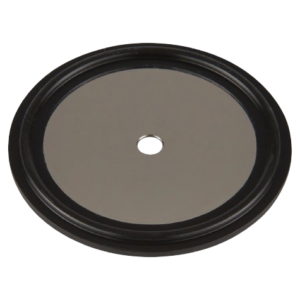
Three models cover all needs: the solid undrilled plate, to be drilled according to the target flow rate; the pre-drilled flat plate with centred or eccentric bore; and the conical vertical plate for self-draining vertical lines. Electropolished 316L stainless steel body, EPDM, FKM, silicone or PTFE gasket.
Tri-clamp calibrated orifice plate gaskets, 3 models
Electropolished 316L stainless steel plate, solid, pre-drilled flat or conical vertical, 1/2″ to 6″
Tri-clamp calibrated orifice plate gasket, electropolished 316L stainless steel plate crimped onto a sanitary gasket. Three models depending on the need: solid plate to be drilled to order, pre-drilled flat plate with concentric or self-draining eccentric bore, conical vertical plate for vertical lines. Fitted between two ferrules like a standard gasket. Gasket in EPDM, FKM, silicone, PTFE or Steam-Flon. Sizes from 1/2″ to 6″, up to 4″ for the vertical plate. DIN 32676 series A, B and C standards.
Setting a flow rate without a valve or tapping
An orifice plate is a thin plate with a hole drilled in it, placed in the pipework. As the fluid passes through the orifice, its velocity increases and its pressure drops downstream, creating a fixed, known pressure drop. This restriction sets a flow rate, balances the branches of a network, limits backflow or breaks pressure during SIP phases, at the gasket plane of an existing fitting.
All without a control valve or additional section, and therefore without any added dead leg. The bore diameter is chosen according to the target pressure drop, by hydraulic calculation on a case-by-case basis.
Three models, three needs
The choice of model depends on the line configuration and how the hole is to be defined.
| Model | Description | When to choose it |
| Solid undrilled plate | Plate delivered without a hole, to be drilled according to the calculated flow rate | When the orifice diameter has not yet been fixed, or to drill it yourself after calculation. The standard version is delivered solid. |
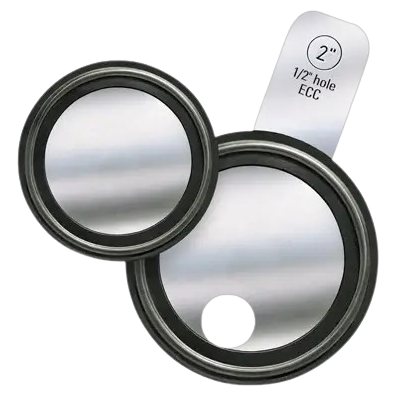
| Pre-drilled flat plate | Concentric centred bore, or eccentric at the bottom of the flow path for self-draining. Engravable tab option | Horizontal or vertical line. The eccentric bore prevents upstream retention on a CIP circuit. The tab identifies the plate in the line and carries the engraved diameter. |
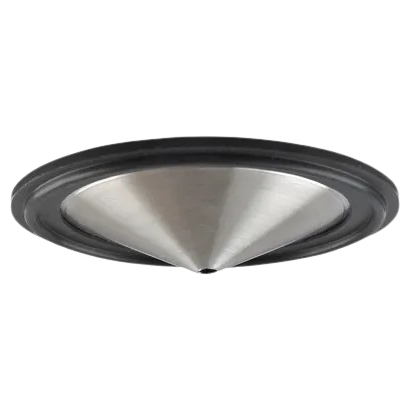
| Conical vertical plate | Conical plate facing downwards, for vertical lines | Vertical line where a horizontal flat plate would retain liquid. The conical shape ensures self-draining. Up to 4″. |
A flat plate placed horizontally in a vertical pipe is not self-draining; it retains liquid upstream. The downward-facing conical plate solves this problem, which is the point of the vertical model.
Bonded gasket or removable gasket
Standard plates with an elastomer gasket are normally bonded to the plate. If the gasket fails, the complete unit is replaced. The removable gasket is offered as an alternative: it makes it easier to machine the holes and prevents contamination of the gasket during drilling.
PTFE is moulded onto the plate. Steam-Flon is available moulded or removable. The choice between bonded and removable depends on whether you drill the plates yourself, and on your replacement approach.
The tab, for identifying and orienting the plate
The tab protrudes from the fitting and signals from the outside that an orifice plate is present in the line, a safety point so that it is neither forgotten nor mistaken. Text can be laser-engraved on it, for example the orifice diameter.
The tab is also used to orient a plate with an eccentric hole. As the hole is always drilled opposite the tab, the tab is oriented upwards during installation, which places the eccentric orifice at the bottom of the flow path for self-draining. The visual marker becomes an installation marker.
Material and manufacturing
The plate is made of 316L stainless steel, electropolished as standard, to remain consistent with the surface requirements of a pharmaceutical circuit. The gasket crimped onto the plate is made from one of the validated compounds in the sanitary range.
| Characteristic | Value |
| Plate | 316L stainless steel, electropolished as standard |
| Models | Solid undrilled, pre-drilled flat, conical vertical |
| Bore | Concentric centred or self-draining eccentric |
| Gasket | EPDM, FKM, Silicone, PTFE, Steam-Flon |
| Bonded or removable gasket | Elastomer bonded as standard, removable as an option |
| Sizes | 1/2″ to 6″ (TC25 to TC167), up to 4″ (TC119) for vertical |
| Standards | DIN 32676 series A, series B (ISO 1127), series C (ASME BPE) |
| Option | Laser-engravable tab, drilling service |
Dimensions and correspondence
The plate is fitted like a standard gasket, on the outside diameter of the ferrule face. The clamp, ferrule and tube correspondence table, common to all versions, is available for download.
The gasket: the sensitive link in the clamp fitting
The quality of a clamp connection depends on three elements: the gasket, the clamp and pipe alignment. An orifice plate places more stress on the gasket than a solid gasket, as the plate stiffens the assembly. A stressed installation or excessive tightening damages it more quickly. Compression is achieved at the torque specified for the clamp, never by feel.
Frequently asked questions
Solid or pre-drilled plate?
The solid plate is the standard version delivered, to be drilled according to the calculated flow rate, which leaves the orifice diameter open until the last moment. The pre-drilled plate comes with its bore defined, concentric or eccentric. If you know the target diameter, the pre-drilled plate saves the drilling step.
Concentric or eccentric?
Concentric by default, on lines with no draining constraint. Eccentric, with the bore at the bottom of the flow path, when the line must drain without retention upstream of the plate, typically on a horizontal CIP circuit.
When is the vertical model needed?
On a vertical line. A flat plate retains liquid upstream there; a downward-facing conical plate ensures self-draining. Available up to 4″.
Bonded or removable gasket?
Bonded as standard: if the gasket fails, the complete plate is replaced. Removable when you drill the plates yourself, to avoid contaminating the gasket during machining and to separate gasket replacement from plate replacement.
How is the bore diameter defined?
By calculating the target pressure drop according to flow rate and fluid. It is a hydraulic sizing exercise, handled case by case, not a catalogue value.
How do I choose the plate size?
On the outside diameter of the ferrule, like the clamp. The range covers 1/2″ to 6″, and up to 4″ for the conical vertical model.