
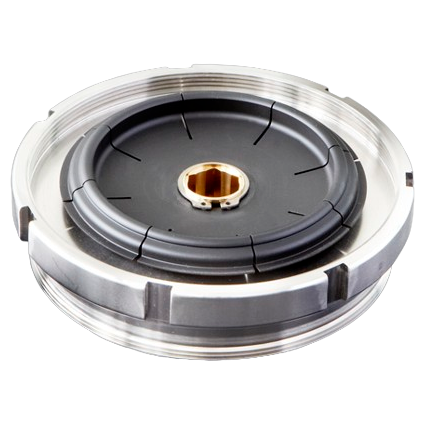
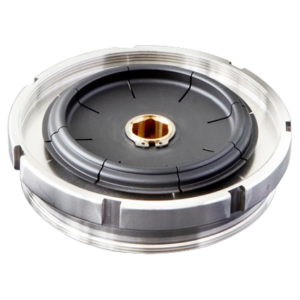
Interface for PTFE Diaphragm, NovAseptic Range
NovAseptic valves are renowned for their performance, reliability, longevity and ease of maintenance. The design and development of each component draw on more than 35 years of experience focused on aseptic design. NovAseptic valves comply with the design qualification criteria established by current GMP (Good Manufacturing Practice) for aseptic processes. This is why we have chosen to describe these valves as aseptic by design.
The range was originally developed to address the challenges of tank bottom valves: no dead zone, self-draining and fully drainable, low pressure drop, the smallest possible weld-in flange diameter to bring the agitator closer to the centre of the tank, very simple maintenance since this valve is generally not accessible, diaphragms suited to the materials of pharmaceutical process tanks, and compact or right-angle actuators. This design was then extended to 2-way or 3-way valves, offering an aseptic alternative to the in-line diaphragm valve.
The range is modular. NovAseptic valve bodies are available in imperial sizes, from 1/2″ to 3″. On each body configuration with the same process connection diameter, all diaphragms, actuators and accessories of that same size can be fitted.
Data sheet
Interface for PTFE diaphragm, type 84
NovaSeptic nomenclature and configurator
Interface for PTFE diaphragm, type 84
Mechanical link between PTFE diaphragm and NovAseptic actuator
Type 84 interface for NovAseptic valves, mandatory with the type 25 PTFE diaphragm. It provides the mechanical link between the rigid PTFE diaphragm and the actuator stem, a link that elastomer diaphragms make directly. Essential whenever a NovAseptic valve is fitted with a PTFE diaphragm.
Why an interface for the PTFE diaphragm
The PTFE diaphragm cannot be attached directly to the actuator stem like an elastomer diaphragm, because of its rigidity and lack of elastic memory. The type 84 interface makes this link: it transmits the actuator movement to the PTFE diaphragm without stressing it to the point of cracking.
The interface is specific to the type 25 PTFE diaphragm. EPDM, FKM and silicone diaphragms do not need it, as their flexibility allows direct attachment. Choosing a PTFE diaphragm therefore always involves the type 84 interface in the same diameter.
Without this interface, the PTFE diaphragm cannot be fitted. It is a component not to be forgotten in the bill of materials of a PTFE diaphragm valve; otherwise the valve is incomplete.
Characteristics
| Characteristic | Value |
| Type | 84 |
| Function | Mechanical link from PTFE diaphragm to actuator |
| Associated diaphragm | PTFE type 25 only |
| Dimensions | 1/2″ to 3″, depending on valve diameter |
| Required for EPDM, FKM, silicone | No |
Frequently asked questions
Why an interface for PTFE only?
Because PTFE is rigid and has no elastic memory, unlike elastomers. It cannot be attached directly to the actuator stem without risk of cracking. The type 84 interface provides this link gently.
Is it needed with EPDM or FKM?
No. Elastomer diaphragms, EPDM, FKM and silicone, are attached directly thanks to their flexibility. The type 84 interface only concerns the type 25 PTFE diaphragm.
Is one interface needed per valve?
Yes, one interface in the valve diameter, whenever the valve is fitted with a PTFE diaphragm. It must be included in the bill of materials in the same way as the diaphragm.