
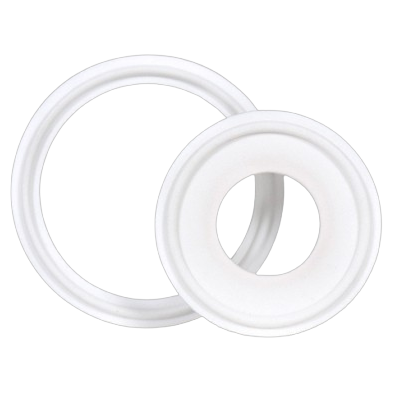


Pure Seal FDA USP Class VI Clamp Gasket
On a tri-clamp connection, sealing is not provided by the clamp but by the gasket. The clamp sets the compression; the gasket turns it into a seal and absorbs the forces from the line. The choice of its material determines the allowable temperature, chemical compatibility and service life of the connection.
Pure Seal is a white aseptic PTFE gasket. It combines flexibility and chemical inertness, and is available with or without lip.
Tubes Technologies gasket selection guide
Pure Seal clamp gaskets, white aseptic PTFE
White-look Gylon equivalent, with or without lip, custom-machined
Pure Seal clamp gasket, the functional equivalent of Gylon in a white finish. Available with or without lip, custom-machined. Good flexibility and good chemical inertness. Less widespread on the market; availability should be checked depending on dimensions. Diameters and service ranges as per the supplier data sheet.
Where this material is the right choice, and where it is not
Pure Seal offers the flexibility and chemical inertness expected of a modern aseptic PTFE, with a white appearance that distinguishes it from blue Gylon. Unlike the flat, lipless Gylon tri-clamp gasket, it is available with or without lip because it is custom-machined, making it possible to benefit from Type II centring with this family of materials. It targets the same demanding applications as Gylon.
Pure Seal is less common on the market, which means availability must be checked depending on dimensions and lead times may be longer. Public technical data is limited: precise temperature ranges, compliance and chemical compatibilities must be obtained from the supplier before any commitment. It is a niche product handled on quotation.
Type I and Type II: the lip changes installation
Type I, or Type B, is a flat gasket without lip. It is centred by hand in the groove of the two ferrules. This is the most common and least expensive version.
Type II, or Type A, has a centring lip that fits into the inside diameter of the ferrule. The gasket positions itself and cannot shift during closing. For Pure Seal, which is custom-machined, both versions are available.
The choice between the two does not depend on the material but on the centring requirement at the installation point.
Material properties
| Characteristic | Value |
| Material | White-look Gylon equivalent |
| Service temperature | to be confirmed as per the supplier data sheet |
| Appearance | White, functional equivalent of Gylon |
| Version | With or without lip, custom-machined |
| Availability | To be checked depending on dimensions |
| Compliance | to be confirmed with the supplier |
| Versions | Type I and Type II, custom-made |
The temperature range and chemical compatibilities come from the supplier’s data. Detailed chemical information is provided in the materials guide and the compatibility sheet, available for download.
Dimensions
Standardised dimensions. The gasket outside diameter corresponds to the ferrule face, the inside diameter to the flow path. A gasket whose inside diameter protrudes into the flow path creates retention; a gasket that is too small opens a crevice.
| Size | Gasket ID (mm) | Gasket OD (mm) | Ferrule flange A (mm) | Tube DN |
| 1″ | 22,9 / 0.900″ | 50,4 / 1.984″ | 50,5 | DN25 |
| 1 1/2″ | 35,6 / 1.400″ | 50,4 / 1.984″ | 50,5 | DN40 |
| 2″ | 48,3 / 1.900″ | 63,9 / 2.515″ | 64 | DN50 |
| 2 1/2″ | 61,0 / 2.400″ | 77,5 / 3.050″ | 77,5 | DN65 |
| 3″ | 73,7 / 2.900″ | 90,9 / 3.579″ | 91 | DN65 |
| 4″ | 98,3 / 3.869″ | 118,9 / 4.682″ | 119 | DN100 |
Millimetre conversions are for guidance only. The complete clamp, ferrule and tube correspondence table is available for download.
The gasket: the sensitive link in the clamp fitting
The quality of a clamp connection depends on three elements: the gasket, the clamp and pipe alignment. The gasket provides the seal and at the same time absorbs the torsional forces transmitted by the line. This dual role is the weak point of the clamp fitting.
A misaligned section makes the gasket work constantly, causing wear and then premature tearing. Excessive tightening pushes the gasket into the flow path and creates a dead leg. The gasket is the consumable part of the connection: it is replaced, not salvaged.
This material compared with others
A gasket material is chosen based on temperature, fluid, dismantling frequency, regulatory requirements and cleaning method. Here is what sets the main materials apart.
| Material | What it offers | Its limitations |
| EPDM (and silicone) | Very flexible, easy to install, economical | Limited temperature, does not withstand oils or solvents |
| FKM Viton | Oils, solvents, acids, up to 204 °C | Strong oxidisers, less flexible, more expensive |
| Solid PTFE | Exceptional chemical and thermal resistance | Rigid, high tightening, creep |
| Gylon 3504 | Flexible, low tightening, creep-resistant, very wide range | Flat without lip, speciality, more expensive |
| Pure Seal | White Gylon equivalent, with or without lip | Less common, availability to be checked |
| Tuf-Flex | PTFE bonded to EPDM, crush-resistant, WFI | More expensive, strong oxidisers to be checked |
| Tuf-Steel | PTFE + 316L stainless steel, creep-resistant, -196 to +288 °C | Expensive, demanding applications |
Each material has a dedicated data sheet with its service ranges, compliance and chemical compatibilities.
Frequently asked questions
Pure Seal or Gylon?
Both are speciality modified PTFEs with similar performance. Gylon is blue, flat without lip in tri-clamp, and more widespread. Pure Seal is white, available with or without lip because it is custom-machined, but less common. The choice depends on availability, appearance and the need for a lip.
How do I choose the size?
On the outside diameter of the ferrule, like the clamp. The gasket inside diameter must be flush with the flow path without protruding. The correspondence table gives the equivalence between size, ferrule and tube.
Which technical data are guaranteed?
The precise temperature ranges, compliance and chemical compatibilities of Pure Seal must be obtained from the supplier. This product is handled on quotation, with a technical data sheet attached.