

SAFETY 316 SAFS Lockable Clamp
Advanced Coupling Clamp Specification
A clamp consists of two half-shells joined by a hinge and closed by a tightening mechanism. On a tri-clamp connection, sealing is achieved by compressing the gasket between the two ferrule faces. The clamp holds this compression and determines how it is distributed around the gasket circumference.
The Safety design takes the geometry of the SH clamp and adds a shouldered eye bolt that prevents opening until the nut has been loosened by the specified number of turns. Four safety levels are available. The clamp’s maximum allowable pressure ranges from 50 bar at 1/2″ to 10 bar at 12″.
Shouldered eye bolt, 4 safety levels, 1/2″ to 12 5/8″, DN8 to DN300
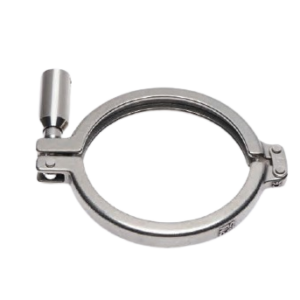
Lockable SAFETY clamp, double-hinged safety clamp, 316 stainless steel body, shouldered eye bolt. Four safety levels, from simple anti-opening up to padlock lockout. Diameters from 1/2″ to 12 5/8″, i.e. DN8 to DN300, compatible with DIN 32676, ISO 2852 and ASME BPE ferrules. Maximum allowable pressure from 50 bar at 1/2″ to 10 bar at 12″. Patented design, anti-galling option across the entire range.
The delayed-opening mechanism
On a standard clamp, the bolt swings free as soon as the nut stops bearing on it. An impact, a vibration, an operator who loosens a quarter turn and turns away: the clamp can open while the line is still under pressure or still hot. The gasket blows out, the fluid escapes, and the operator is right in front of it.
The shouldered eye bolt eliminates this scenario. The shoulder is held in a grooved seat and cannot pivot until the nut has been loosened by the specified number of turns. During these turns, gasket compression decreases gradually: any residual pressure shows up as an audible, controlled leak before the clamp can open. The operator is warned before being exposed.
The nut does not need to be fully removed to open the clamp. Normal operation remains quick; only accidental opening is prevented.
The four safety levels
The level is chosen according to the nature of the risk, not the pressure. A point carrying 3 bar steam at 140 °C warrants a higher level than a cold process line at 20 bar.
| Level | Designation | Composition | Use |
| 1 | SAF | Shouldered eye bolt | Accidental opening prevented, hand-operated |
| 2 | SAFX | Shouldered eye bolt, hex nut | Tool-operated opening, traceable torque tightening |
| 3 | SAFS | Shouldered eye bolt, hex nut, cover | Restricted access to the nut, thread protection |
| 4 | SAFL | Shouldered eye bolt, hex nut, cover, lockout device | Points included in a padlock lockout procedure |
Level 4 accepts a lockout padlock. The clamp then becomes part of the LOTO procedure just like an isolator or a valve: the line cannot be reopened by a third party during an intervention.
Two versions complete the range: a double-bolt version for 2 1/2″ to 5″ connections, and a three-segment version in 304L for points that are opened frequently.
Material and surface finish
316 stainless steel body. The clamp remains outside the process and comes into contact neither with the fluid nor with internal CIP solutions. It is, however, exposed to floor washdowns, ambient steam, splashes of alkaline detergents and, in microelectronics, acidic atmospheres. Grade 316 limits the onset of crevice corrosion in the overlapping areas of the hinges.
The anti-galling option is available across the entire range. On a safety clamp, a galled thread turns a controlled opening into a grinder job, which defeats the purpose of the device. On hot points and circuits subjected to repeated SIP, this option is not a luxury.
Wing nuts are available in coloured versions to visually identify a network or a fluid class on an installation that has several.
Pressure rating
The maximum allowable pressure depends on the diameter and follows the values of the SH clamp from which the geometry is derived. It applies to the clamp alone.
| Diameter | DN equivalent | Flange A (mm) | MAWP (bar) |
| 1/2″ to 2 1/2″ | DN8 to DN50 | 25.4 to 77.5 | 50 |
| 3″ and 3 1/2″ | DN65 and DN80 | 91 and 106 | 40 |
| 4″ | DN100 (DIN) | 119 | 35 |
| 4 1/2″ to 6″ | DN100 (ISO) to DN125 | 130 to 167 | 30 |
| 6 5/8″ | DN150 | 183 | 25 |
| 8″ and 8 5/8″ | DN200 | 217.4 and 233.5 | 20 |
| 10″ and 10 5/8″ | DN250 | 268 and 286.1 | 16 |
| 12″ and 12 5/8″ | DN300 | 319 and 338 | 10 |
The allowable pressure of the complete assembly depends on the gasket, its material, the operating temperature and the ferrule tolerances. The values in the table are the mechanical limit of the clamp at ambient temperature, not that of the connection. The entire range has been pressure-tested by a third-party body; reports available on request.
Standards compatibility
The clamp is defined by the outside diameter of the ferrule face, not by the tube DN. It therefore applies equally to ferrules made to DIN 32676 series A, B and C, ISO 2852 and ASME BPE, provided the flange diameter matches.
Depending on the case, the associated tubes conform to DIN 11850, EN 10357 series A to C, DIN 11866 or ISO 2037. The hygienic classes H3, H4 and H5 of DIN 11866 make it possible to trace the correspondence between tube, fitting and internal surface finish.
Gasket selection
The clamp is independent of the gasket. The elastomer material, EPDM, silicone, FKM or PTFE, is selected based on chemical compatibility and operating temperature, then on the food or pharmaceutical compliance requirements applicable to the project. It is this choice that sets the allowable temperature of the connection, not the clamp.
On hot lines, it is also the gasket that governs the risk on opening. A gasket that has crept or aged thermally can stick to the faces and release its stress all at once when it comes loose. The shouldered eye bolt holds the assembly together during this phase.
Overall dimensions
Band width of 17 mm on single-bolt versions, 19 mm on the double-bolt version. Flange diameter from 25.4 mm to 338 mm. Levels 3 and 4, cover and lockout device, increase the radial footprint around the nut: to be checked on insulated lines and tightly packed pipe racks.
Applications
Hazardous process lines, steam circuits and hot points, solvent distribution, pharmaceutical and biotechnology industries, chemicals, microelectronics, food processing.
This type of clamp is specified by name in the internal standards of several pharmaceutical groups, on connections that are frequently dismantled in hazardous areas. Patented design. Periodic inspections by third-party bodies. Clamps calibrated from batch to batch to ensure consistent fit on the ferrule. Packed in cardboard, plastic-free.
Technical specifications
| Characteristic | Value |
| Type | Safety SH, double hinge, shouldered eye bolt |
| Safety levels | 4, from the shouldered bolt alone to the lockout device |
| Body material | 316 stainless steel, 3-segment version in 304L |
| Fasteners | Shouldered eye bolt, wing nut or hex nut, anti-galling option |
| Size range | 1/2″ to 12 5/8″ (DN8 to DN300) |
| Flange diameter | 25.4 mm to 338 mm |
| Band width | 17 mm single bolt, 19 mm double bolt |
| MAWP | 50 bar at 1/2″ to 10 bar at 12″ |
| Compatible ferrules | DIN 32676 series A, B, C, ISO 2852, ASME BPE |
| Options | Coloured wing nuts for network identification |
| Delivery | Assembled, ready to install |
| Packaging | Cardboard, plastic-free |
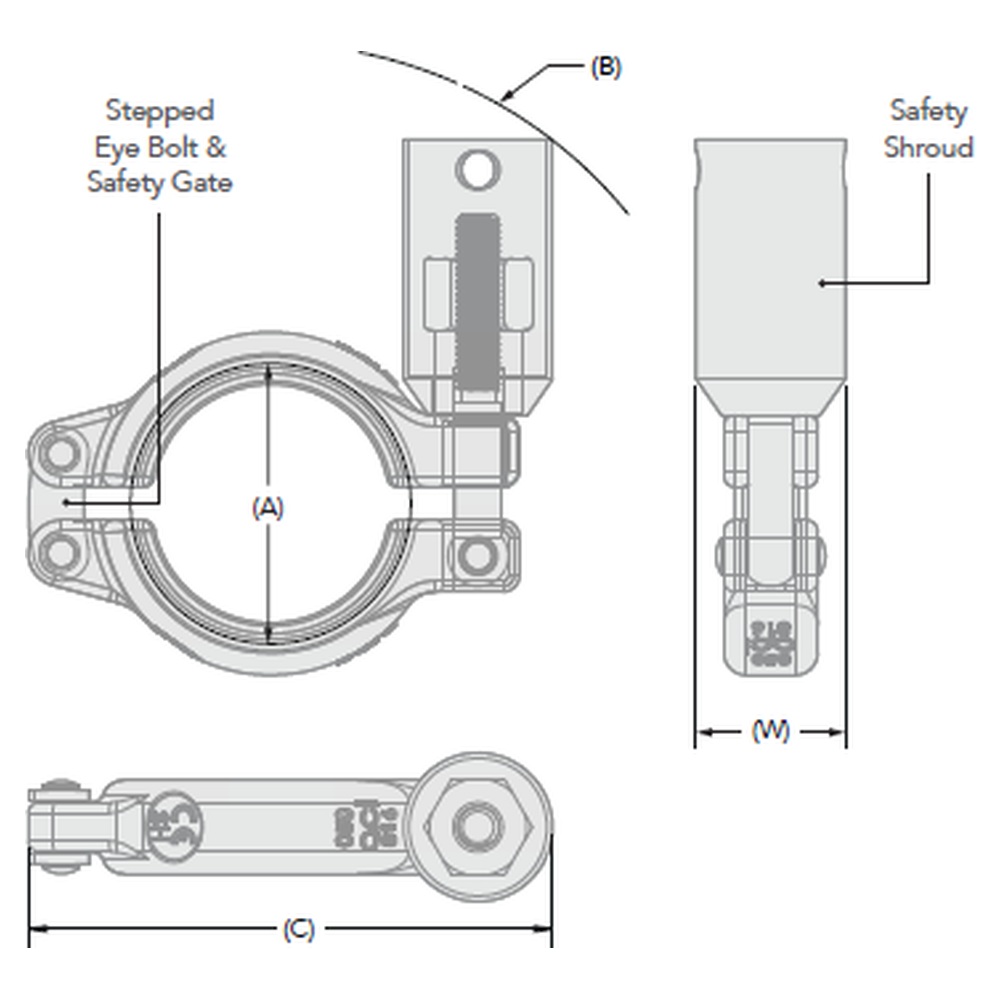
Dimensional drawing key: A flange diameter (ferrule face), B opening radius, C overall length, W band width.
Clamp and ferrule correspondence
The clamp flange diameter A corresponds to the outside diameter of the ferrule face, not to the tube DN. A DN25 tube fitted with a 1″ ferrule takes a clamp with a 50.5 mm flange. The same DN25 fitted with a DIN ferrule takes a clamp with a 34 mm flange. The table below gives the equivalence between clamp size, ferrule size and tube diameter for the ASME BPE, DIN 32676 and ISO 2852 standards.
Other clamp versions
The safety clamp is the obvious choice for high-risk points. The other versions meet different requirements.
| Version | Closure | Use |
| Safety, 4 levels | 1 shouldered eye bolt, 2 pins | Points where accidental opening under pressure must be prevented, 1/2″ to 12 5/8″ |
| SH single bolt, double hinge | 1 bolt, 2 pins | Standard connections from 50 to 10 bar depending on diameter, frequent dismantling |
| Double hex nut | 1 bolt, 2 nuts | Controlled, traceable torque tightening |
| Reinforced double-bolt SSH | 2 bolts, 2 segments | High pressure, from 75 to 20 bar depending on diameter |
| Three segments | 1 bolt, 3 riveted segments | Frequent one-handed opening, from 21 to 12 bar, 1″ to 4″ |
| Polymer, single-use | Quick closure | Bags, filters and disposable lines, -70 °C to 60 °C |
Single-use polymer clamps cover a standard range of -70 °C to 60 °C, freezing down to -80 °C, autoclaving up to 134 °C for 30 minutes and gamma sterilisation up to 50 kGy.
Frequently asked questions
How does it differ from a standard SH clamp?
The geometry and pressure rating are identical. Only the closing mechanism differs: the shouldered eye bolt cannot pivot until the nut has been loosened by the specified number of turns. The clamp therefore does not open as a result of an impact or partial loosening.
Which safety level should I choose?
Level 1 for points where only accidental opening needs to be prevented. Level 2 when opening must require a tool and tightening must be traceable. Level 3 to restrict access to the nut. Level 4 for points included in a lockout procedure. The criterion is the nature of the risk, not the operating pressure.
How do I choose the size?
The choice is based on the outside diameter of the ferrule, dimension A. The tube DN is not enough: a DN25 exists with a 34 mm ferrule and with a 50.5 mm ferrule, depending on the standard.
Wing nut or hex nut?
The wing nut suits connections dismantled by hand in production. The hex nut is chosen when a tightening torque must be applied and recorded, and when opening must require a tool. This is what distinguishes level 1 from level 2.
Is the anti-galling option necessary?
On hot points and circuits subjected to repeated SIP, yes. A galled thread forces a destructive opening, which removes the benefit of the safety device and puts the line out of service.
Which pressure should be used for a technical file?
That of the gasket under its actual operating conditions. The stated MAWP value applies to the clamp alone, at ambient temperature.