
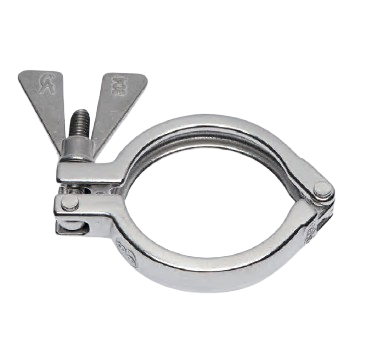
SL 304L Single Hinge Clamp
A clamp consists of two half-shells joined by a hinge and closed by a tightening mechanism. On a tri-clamp connection, sealing is achieved by compressing the gasket between the two ferrule faces. The clamp holds this compression and determines how it is distributed around the gasket circumference.
The SL design combines a single hinge with a wing-nut tightening bolt. Eight sizes, from 1/2″ to 4″, for a maximum allowable pressure of 25 bar to 17 bar depending on the diameter.
Advanced Coupling Clamp Specification
Single-bolt closure, one pin, 1/2″ to 4″, DN8 to DN100
SL 304L clamp with single hinge and wing nut, 304L stainless steel body, external finish 0.8 µm Ra max. Eight sizes from 1/2″ to 4″, i.e. DN8 to DN100, compatible with DIN 32676, ISO 2852 and ASME BPE ferrules. Maximum allowable pressure from 25 bar at 1/2″ to 17 bar at 4″, calculated to ASME VIII Div. 1 App. 24. Delivered assembled, tool-free installation and removal.
One pin, one bolt, half the pressure
The key figure to remember above all else: at equal diameter, this clamp withstands about half the pressure of a double-hinge clamp. 25 bar versus 50 bar at 2″. 20 bar versus 40 bar at 3″. 17 bar versus 35 bar at 4″.
The reason is mechanical. A single hinge, a single load-bearing point, a lighter band geometry. The clamp is not undersized; it is sized for a different field of application.
That field exists and it is broad: utility networks, water distribution, returns and drains, low-pressure transfer lines, hose connections, temporary workshop set-ups. At these points, an MAWP of 25 bar is well above requirements, and paying for a double hinge amounts to buying unused reserve capacity.
What the single hinge changes
The clamp closes by rotating around a single pin. The free half-shell approaches the ferrule at an angle and loads the gasket sideways before compression. The gasket can shift, and the faces become marked over the cycles.
On a connection installed once and rarely reopened, this behaviour has no consequence: the gasket is positioned once, correctly, and left alone. On a point dismantled every week, it results in re-tightening and rising gasket consumption.
This is the real selection criterion between SL and double hinge. Not price, not grade: dismantling frequency.
Material and surface finish
304L stainless steel body. External finish 0.8 µm Ra max.
304L covers utilities, water, compressed air, low-pressure steam and most food processing lines. It is not the right choice in chlorinated atmospheres, at the seaside, in washrooms exposed to concentrated alkaline detergents, or on halogenated solvent circuits. In these environments, a 316L version should be used instead.
The fasteners are available in a galling-resistant version. On a wing-nut clamp tightened and loosened by hand, a galled thread calls for pliers, then a grinder.
Pressure rating
The maximum allowable pressure depends on the diameter. It is calculated to ASME VIII Division 1, Appendix 24, and applies to the clamp alone.
| Diameter | DN equivalent | Flange A (mm) | MAWP (bar) |
| 1/2″ to 3/4″ | DN6 to DN10 | 25,4 | 25 |
| DN10 to DN20 | DN10-15-20 | 34 | 25 |
| 1″ to 1 1/2″ | DN25 to DN40 | 50,5 | 25 |
| 2″ | DN50 | 64 | 25 |
| 2 1/2″ | DN50 (ISO) | 77,5 | 25 |
| 3″ | DN65 | 91 | 20 |
| 3 1/2″ | DN80 | 106 | 20 |
| 4″ | DN100 (DIN) | 119 | 17 |
The allowable pressure of the complete assembly depends on the gasket, its material, the operating temperature and the ferrule tolerances. The values in the table are the mechanical limit of the clamp at ambient temperature, not that of the connection.
Standards compatibility
The clamp is defined by the outside diameter of the ferrule face, not by the tube DN. It therefore applies equally to ferrules made to DIN 32676 series A, B and C, ISO 2852 and ASME BPE, provided the flange diameter matches.
Depending on the case, the associated tubes conform to DIN 11850, EN 10357 series A to C, DIN 11866 or ISO 2037. The hygienic classes H3, H4 and H5 of DIN 11866 make it possible to trace the correspondence between tube, fitting and internal surface finish.
Gasket selection
The clamp is independent of the gasket. The elastomer material, EPDM, silicone, FKM or PTFE, is selected based on chemical compatibility and operating temperature, then on the food or pharmaceutical compliance requirements applicable to the project. It is this choice that sets the allowable temperature of the connection, not the clamp.
On a single hinge, gasket placement matters more than elsewhere. A gasket centred before closing, in a clean groove, eliminates most of the risk of shifting. A gasket fitted in a hurry ends up pinched on one sector and leaks at the first pressure cycle.
Overall dimensions
Band width of 17 mm across the entire range. Overall length from 60 mm to 154 mm depending on size. Flange diameter from 25.4 mm to 119 mm. This is the smallest footprint in the clamp range, making it a useful solution on tightly packed pipe racks and compact skids.
Applications
Utility networks, water distribution, compressed air, low-pressure steam, transfer lines, returns and drains, food processing, brewing, cosmetics, test set-ups and prototyping.
A design in service for more than 30 years, optimised for installation and maintenance. Periodic inspections by third-party bodies. Clamps calibrated from batch to batch to ensure consistent fit on the ferrule. Packed in cardboard, plastic-free.
Technical specifications
| Characteristic | Value |
| Type | SL, single bolt, single hinge (1 pin) |
| Body material | 304L stainless steel |
| External finish | 0.8 µm Ra max |
| Fasteners | Wing nut, galling-resistant version available |
| Size range | 1/2″ to 4″ (DN8 to DN100) |
| Flange diameter | 25.4 mm to 119 mm |
| Band width | 17 mm across the entire range |
| MAWP | 25 bar at 1/2″ to 17 bar at 4″, ASME VIII Div. 1 App. 24 |
| Compatible ferrules | DIN 32676 series A, B, C, ISO 2852, ASME BPE |
| Installation | Tool-free, by hand |
| Delivery | Assembled, ready to install |
| Packaging | Cardboard, plastic-free |
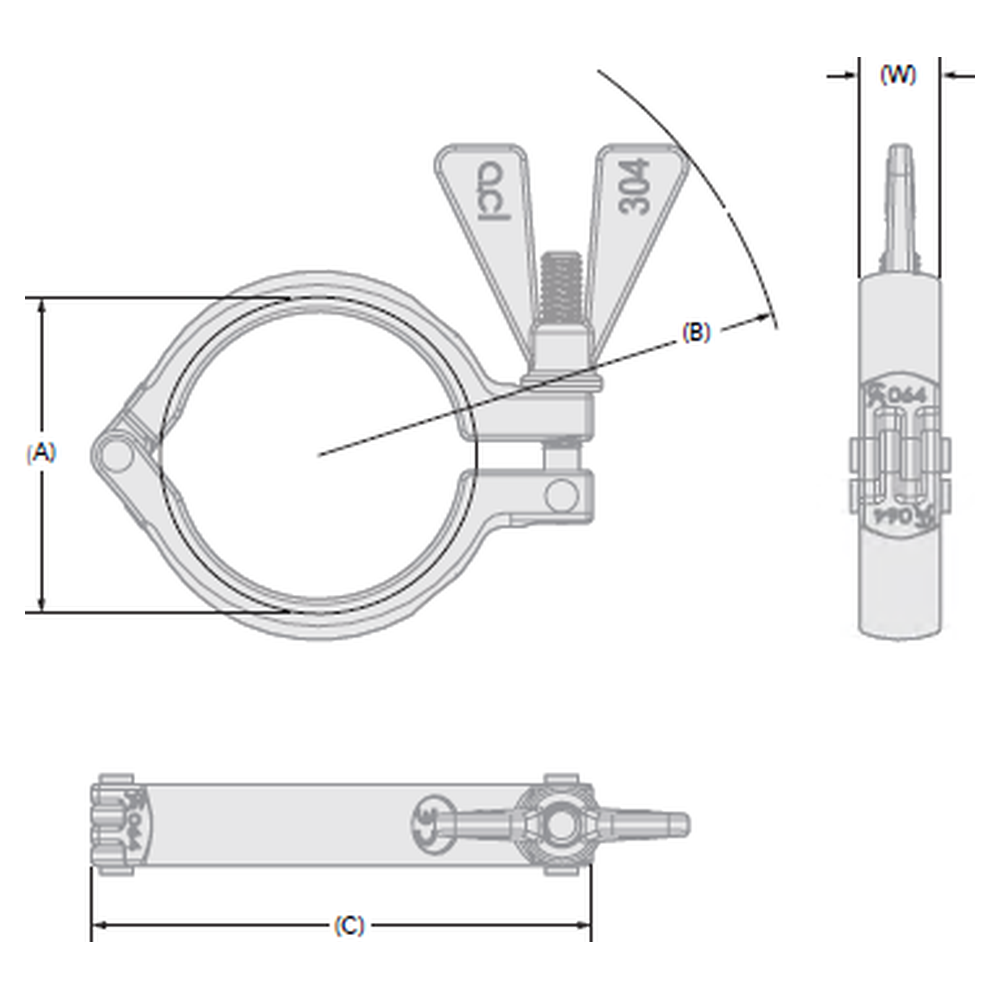
Dimensional drawing key: A flange diameter (ferrule face), B opening radius, C overall length, W band width.
Clamp and ferrule correspondence
The clamp flange diameter A corresponds to the outside diameter of the ferrule face, not to the tube DN. A DN25 tube fitted with a 1″ ferrule takes a clamp with a 50.5 mm flange. The same DN25 fitted with a DIN ferrule takes a clamp with a 34 mm flange. The table below gives the equivalence between clamp size, ferrule size and tube diameter for the ASME BPE, DIN 32676 and ISO 2852 standards.
Other clamp versions
The SL covers service connections and utilities. The other versions meet requirements that a single hinge does not address.
| Version | Closure | Use |
| SL single hinge | 1 bolt, 1 pin | Utilities and service connections, from 25 to 17 bar, 1/2″ to 4″ |
| SH single bolt, double hinge | 1 bolt, 2 pins | Process connections from 50 to 10 bar, DN8 to DN300, frequent dismantling |
| SH double bolt, wing nut | 2 adjustable swing bolts | Symmetrical tightening, 2 1/2″ to 10″ |
| Safety, 4 levels | 1 shouldered eye bolt, 2 pins | Points where accidental opening under pressure must be prevented |
| Reinforced SSH | 2 bolts, 2 separate segments | High pressure, from 75 to 20 bar depending on diameter |
| Three segments | 1 bolt, 3 riveted segments | Frequent one-handed opening, from 21 to 12 bar, 1″ to 4″ |
| Polymer, single-use | Quick closure | Bags, filters and disposable lines, -70 °C to 60 °C |
Frequently asked questions
SL or double hinge?
The SL for a connection installed once and rarely reopened, below 17 bar operating pressure. The double hinge as soon as there is recurring dismantling, periodic gasket replacement or difficult access, and always above the SL’s MAWP. The criterion is opening frequency, before pressure.
Why is the MAWP half as high?
A single hinge, a single load-bearing point, a lighter band. The clamp is sized for a different field of application, not lightened at the expense of safety. The values are calculated to the same reference, ASME VIII Div. 1 App. 24.
304L or 316L?
304L covers utilities, water, air and most food processing lines. 316L is required in chlorinated atmospheres, at the seaside, in washrooms exposed to concentrated alkaline detergents and with halogenated solvents. This range is only available in 304L.
How do I choose the size?
The choice is based on the outside diameter of the ferrule, dimension A. The tube DN is not enough: a DN25 exists with a 34 mm ferrule and with a 50.5 mm ferrule, depending on the standard.
Can it be used in the pharmaceutical industry?
On utilities and non-critical circuits, yes. On PW and WFI loops, product lines and any point subject to qualification, grade 316L and a double hinge are expected. The question is not decided on the clamp alone but on the circuit classification and maintenance.
Which pressure should be used for a technical file?
That of the gasket under its actual operating conditions. The stated MAWP value applies to the clamp alone, at ambient temperature.