


Tuf Flex FDA USP Class VI Clamp Gasket
On a tri-clamp connection, sealing is not provided by the clamp but by the gasket. The clamp sets the compression; the gasket turns it into a seal and absorbs the forces from the line. The choice of its material determines the allowable temperature, chemical compatibility and service life of the connection.
Tuf-Flex bonds a PTFE layer onto an elastomer core. The contact surface has the inertness of PTFE, while the body retains the elastic memory of an elastomer. Two cores are available: EPDM up to 149 °C, FKM up to 204 °C.
Rubber Fab materials and chemical compatibility guide
Tubes Technologies gasket selection guide
Rubberfab references, Tuf flex PTFE / EPDM gasket
Rubberfab references, Tuf flex PTFE / FKM gasket
Guidelines for sanitary gasket materials
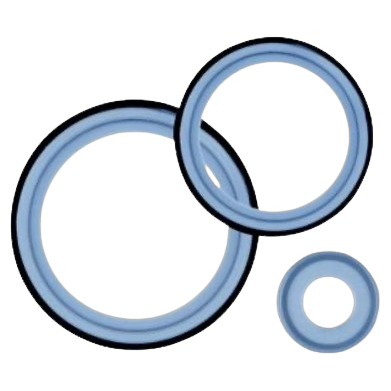
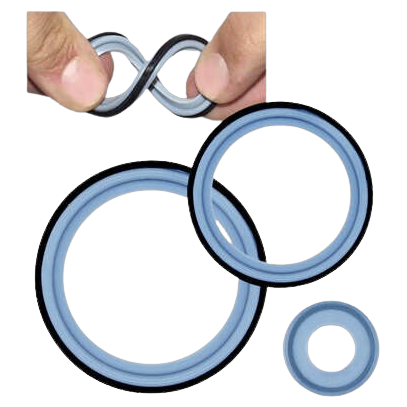
Bonded unitised gasket, choice of two cores, without lip and with lip
Tuf Flex clamp gasket, the only unitised gasket in the world: a PTFE layer bonded onto an elastomer core, fully joined. Two versions depending on the core, PTFE on EPDM up to +149 °C, PTFE on FKM up to +204 °C. It combines the chemical inertness of PTFE with the elastic memory of the elastomer. Designed for biopharmaceuticals, ultra-pure water and WFI. Available without lip and with lip. USP Class VI compliant. Diameters from 1/2″ to 12″. Imparts no taste or odour.
The unitised principle, common to both versions
Tuf-Flex resolves the compromise of the critical sanitary fitting. Solid PTFE creeps and leaks at delta T. An enveloped gasket, whose two materials are not bonded, gives inconsistent results and also creeps over time. A bare elastomer leaches extractables.
Tuf-Flex presents the fluid with a PTFE surface bonded onto the core in a single, fully joined part, not simply enveloped. The result: no leaching of elastomer or particles, and the elastic memory of the core is retained, so no re-tightening is needed. The gasket maintains its inside diameter without re-tightening or leaking, including under SIP cycles. It is the gasket for WFI, ultra-pure water and demanding biopharmaceutical applications. It imparts no taste or odour, which also makes it suitable for challenging food processing applications.
Two cores, two fields of application
The only difference between the two versions is the core material, beneath an identical PTFE surface. This core sets the allowable temperature and the behaviour if the envelope is breached.
| Version | Core | Temperature | What it specifically offers |
| Tuf-Flex PTFE/EPDM | EPDM, black and blue | -29 °C to +149 °C | Standard version, aqueous circuits, WFI, ultra-pure water. The best performance-to-cost ratio in the unitised range. |
| Tuf-Flex PTFE/FKM | FKM, fluoroelastomer | -29 °C to +204 °C | High-temperature version. If the PTFE envelope is breached, the FKM core resists a wide range of chemicals, oils and solvents, where an EPDM core would fail. |
The choice is based on two criteria. Temperature first: above 149 °C, the FKM core is mandatory. Chemical safety second: on a line where an envelope incident would expose the core to oils or solvents, the FKM version holds where EPDM would swell. On a conventional aqueous circuit below 149 °C, the EPDM version is sufficient and costs less.
Where Tuf-Flex is the right choice, and where it is not
Tuf-Flex is the obvious choice wherever purity and dimensional stability under SIP are the priority: WFI, ultra-pure water, bioprocesses, sterile filling points, taste-sensitive food processing lines. Its PTFE surface does not leach, its elastic memory avoids re-tightening, and it maintains its inside diameter cycle after cycle.
It is more expensive than a standard elastomer or an enveloped gasket. On a simple line with no purity requirement or SIP cycling, it represents an extra cost with no useful benefit. Its compatibility must be checked with highly oxidising products, as for any PTFE. The choice of core must be explicit: an EPDM version installed on a 180 °C line would be outside its range.
Type I and Type II: the lip changes installation
Type I, or Type B, is a flat gasket without lip. It is centred by hand in the groove of the two ferrules.
Type II, or Type A, has a centring lip that fits into the inside diameter of the ferrule. The gasket positions itself and cannot shift during closing. Tuf-Flex is available in both versions, whatever the core.
The choice between the two does not depend on the material but on the centring requirement at the installation point.
Material properties
| Characteristic | Value |
| Construction | Unitised PTFE bonded onto an elastomer core, fully joined |
| EPDM core | -29 °C to +149 °C (-20 °F to 300 °F), black and blue |
| FKM core | -29 °C to +204 °C (up to 400 °F), chemical safety in the event of a breach |
| Contact surface | PTFE, no leaching, no taste or odour |
| SIP cycles | Inside diameter maintained without re-tightening |
| Compliance | USP Class VI |
| Versions | Type I without lip, Type II with centring lip |
| Diameters | 1/2″ to 12″ |
The temperature ranges and chemical compatibilities come from the manufacturer’s data. Detailed chemical information is provided in the materials guide and the compatibility sheet, available for download.
Dimensions
Standardised dimensions, common to all tri-clamp gasket materials. The gasket outside diameter corresponds to the ferrule face, the inside diameter to the flow path. A gasket whose inside diameter protrudes into the flow path creates retention; a gasket that is too small opens a crevice.
| Size | Gasket ID (mm) | Gasket OD (mm) | Ferrule flange A (mm) | Tube DN |
| 1″ | 22,9 / 0.900″ | 50,4 / 1.984″ | 50,5 | DN25 |
| 1 1/2″ | 35,6 / 1.400″ | 50,4 / 1.984″ | 50,5 | DN40 |
| 2″ | 48,3 / 1.900″ | 63,9 / 2.515″ | 64 | DN50 |
| 2 1/2″ | 61,0 / 2.400″ | 77,5 / 3.050″ | 77,5 | DN65 |
| 3″ | 73,7 / 2.900″ | 90,9 / 3.579″ | 91 | DN65 |
| 4″ | 98,3 / 3.869″ | 118,9 / 4.682″ | 119 | DN100 |
Millimetre conversions are for guidance only, based on the manufacturer’s dimensions in inches. The complete clamp, ferrule and tube correspondence table is available for download.
The gasket: the sensitive link in the clamp fitting
The quality of a clamp connection depends on three elements: the gasket, the clamp and pipe alignment. The gasket provides the seal and at the same time absorbs the torsional forces transmitted by the line. This dual role is the weak point of the clamp fitting.
A misaligned section makes the gasket work constantly, causing wear and then premature tearing. Excessive tightening pushes the gasket into the flow path and creates a dead leg. The gasket is the consumable part of the connection: it is replaced, not salvaged.
Tuf-Flex compared with other materials
A gasket material is chosen based on temperature, fluid, dismantling frequency, regulatory requirements and cleaning method. Here is what sets the main materials apart.
| Material | What it offers | Its limitations |
| Tuf-Flex PTFE/EPDM | Unitised, PTFE surface, elastic memory, WFI, creep-resistant | EPDM core limited to 149 °C, more expensive than an elastomer |
| Tuf-Flex PTFE/FKM | Same, plus higher temperature and chemical safety in the event of a breach | The most expensive in the Tuf-Flex family |
| Solid PTFE | Chemical and thermal resistance, inertness | Rigid, creep, leaks at delta T under SIP |
| EPDM/PTFE enveloped | Economical compromise, PTFE face | Not bonded, inconsistent results, creeps over time |
| Tuf-Steel | PTFE + 316L stainless steel, creep-resistant, -196 to +288 °C | Expensive, reserved for extreme applications |
| EPDM | Flexible, economical, aqueous circuits | Leaches, withstands neither oils nor high temperature |
Each material has a dedicated data sheet with its service ranges, compliance and chemical compatibilities.
Frequently asked questions
EPDM core or FKM core?
The EPDM core covers aqueous circuits up to 149 °C; it is the standard and most economical version. The FKM core goes up to 204 °C and, if the PTFE envelope is breached, resists oils and solvents where EPDM would swell. FKM for high temperature or chemical safety, EPDM otherwise.
Tuf-Flex or enveloped PTFE?
Enveloped PTFE encases a core without being bonded to it, which gives inconsistent results between the two materials and creeps over time. Tuf-Flex bonds the PTFE onto the core in a single unitised part, which maintains the inside diameter without re-tightening. With repeated SIP, the difference in service life is clear.
What happens if the PTFE envelope is punctured?
On the FKM version, the exposed core resists a wide range of chemicals, which limits the consequences of an incident. On the EPDM version, the exposed core withstands aqueous media but not oils or solvents. This is a selection criterion on lines with a chemical risk.
Type I or Type II?
Type I, without lip, for standard installation. Type II, with centring lip, when the gasket must position itself. Both cores are available in both versions.
How do I choose the size?
On the outside diameter of the ferrule, like the clamp. The gasket inside diameter must be flush with the flow path without protruding. The correspondence table gives the equivalence between size, ferrule and tube.