
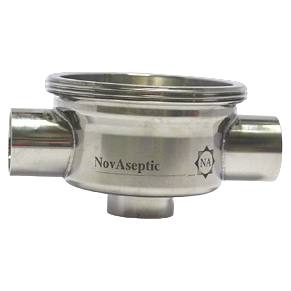


Type 32 Valve Body, 3-Way T-Valve
Weld-end valve body data sheet
Clamp-end valve body data sheet
NovaSeptic nomenclature and configurator
NovAseptic valves are renowned for their performance, reliability, longevity and ease of maintenance. The design and development of each component draw on more than 35 years of experience focused on aseptic design. NovAseptic valves comply with the design qualification criteria established by current GMP (Good Manufacturing Practice) for aseptic processes. This is why we have chosen to describe these valves as aseptic by design.
The range was originally developed to address the challenges of tank bottom valves: no dead zone, self-draining and fully drainable, low pressure drop, the smallest possible weld-in flange diameter to bring the agitator closer to the centre of the tank, very simple maintenance since this valve is generally not accessible, diaphragms suited to the materials of pharmaceutical process tanks, and compact or right-angle actuators. This design was then extended to 2-way or 3-way valves, offering an aseptic alternative to the in-line diaphragm valve.
The range is modular. NovAseptic valve bodies are available in imperial sizes, from 1/2″ to 3″. On each body configuration with the same process connection diameter, all diaphragms, actuators and accessories of that same size can be fitted.
3-way T diaphragm valve, aseptic diverting or mixing, 1/2″ to 3″
NovAseptic type 32 valve body, 3-way T configuration. Aseptic design with no dead zone, drainable, low pressure drop. Electropolished body with Ra below 0.38 µm, several stainless steel grades depending on the process. Process pressure -1 to 7 bar. Imperial sizes 1/2″ to 3″. Straight or angled outlet, weld or tri-clamp connection. EN 10204-3.1 certificate, ATEX version available. Category: process diaphragm valves.
An aseptic alternative to the in-line valve
Type 32 is a 3-way T body, for diverting or mixing two flows at an aseptic point. It replaces an assembly of in-line valves with a single drainable body, reducing dead volumes and the number of points to qualify.
The T configuration handles diverting or mixing depending on the diaphragm control direction, with no dead zone at the junction point.
A single 3-way body replaces two 2-way valves and the section between them, eliminating the corresponding potential retention points.
Body and specifications
The body is available in several grades depending on the aggressiveness of the process, with a straight or angled outlet, and a weld or tri-clamp connection.
| Characteristic | Value |
| Type | 32, 3-way T body |
| Category | Process diaphragm valves |
| Dimensions | Imperial, 1/2″ to 3″ |
| Body grades | 316L, 1.4435 BN2, 904L, AL6XN, Hastelloy C22 |
| Outlet | Straight BW, 45° angled or 90° angled |
| Connection | BW (weld) or Tri-clamp |
| Surface finish | Ra below 0.38 µm, electropolished |
| Process pressure | -1 to 7 bar |
| Certificate | EN 10204-3.1 |
| ATEX | Available |
Compatible diaphragms
The type 32 body accepts the four diaphragms in the range, all FDA and USP Class VI, to be chosen according to the fluid and operating temperature.
| Diaphragm | Type | Compliance |
| EPDM | 22 | FDA and USP Class VI |
| FKM Viton | 24 | FDA and USP Class VI |
| PTFE | 25 | FDA and USP Class VI |
| Silicone | 26 | FDA and USP Class VI |
The type 25 PTFE diaphragm requires the type 84 interface. Diaphragm selection follows chemical compatibility and temperature, as for any product-contact component.
Compatible actuators and accessories
The type 32 body can be operated by all actuators in the range, from manual to ATEX pneumatic, to be chosen according to the control mode, accessibility and zone classification.
| Actuator or accessory | Type |
| Manual, stainless steel base, plastic handle | 150 |
| Manual, all stainless steel, autoclavable | 170 |
| Manual, disengageable | NA12 170 |
| Manual with right-angle drive | 180 |
| Pneumatic NC, all stainless steel | 110 |
| Pneumatic NC, plastic, stainless steel base | 111 |
| Pneumatic NO, all stainless steel | 100 |
| Pneumatic double-position, all stainless steel | 140 |
| Pneumatic NC, all stainless steel, ATEX | AX110 |
| Inductive limit switch box | PA1251 |
| ATEX inductive limit switch box | PA11-SEV |
| Interface for PTFE diaphragm | 84 |
Frequently asked questions
Why a NovAseptic process body rather than an in-line diaphragm valve?
Because it brings the aseptic, dead-zone-free design of the tank bottom range to process configurations. The body remains drainable where a conventional in-line valve retains a dead volume.
Which body grade should I choose?
316L covers most pharmaceutical processes. Grades 1.4435 BN2, 904L, AL6XN and Hastelloy C22 meet the needs of more aggressive or more chlorinated fluids, in order of increasing corrosion resistance.
Which diaphragm and which actuator?
All diaphragms and actuators of the same diameter can be fitted on this body. The diaphragm is chosen based on the fluid and temperature, the actuator based on the control mode and zone classification. See the dedicated data sheets.
Straight or angled outlet?
Depending on the line geometry. Straight BW outlet for an in-line exit, 45° or 90° angled to change direction without adding a separate elbow, which limits dead volumes.