
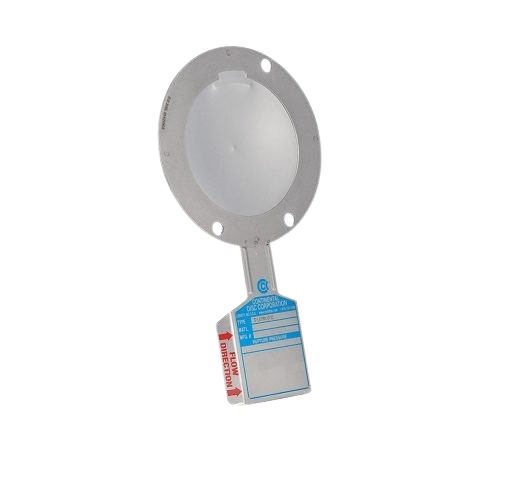
LOTRX® Very Low Pressure Disc
At 104 mbar, a conventional rupture disc no longer has enough metal to be leak-tight, stable and accurate all at once.
Continental Disc®’s LOTRX® gets around the physics with three mechanical features: an initiation indentation at the top of the dome, a notched outlet ring and a vacuum-support inlet ring.
The result: a reverse-acting disc with burst pressures from 0.104 to 2.07 barg, from DN 25 to DN 200, that withstands full vacuum and opens cleanly along its semi-circular score.
LOTRX® installation guide (PDF)
LOTRX®, reverse-acting rupture disc for very low pressures
Scored reverse-acting disc with initiation indentation, 0.104 to 2.07 barg, DN 25 to DN 200, ZERO, -5%, -10% ranges, 90% ratio, full vacuum from 0.345 barg, up to 538°C
Scored reverse-acting rupture disc, designed for very low pressures. The initiation indentation, located at or near the top of the dome, lowers the pressure at which the dome reverses. The notched outlet ring guides opening along the precision semi-circular score, even at the lowest reversal pressures. The back-pressure support inlet ring allows operation under full vacuum for burst pressures of 0.345 barg (5 psig) and above.
High-precision manufacturing method to achieve and control burst pressure within a tight tolerance. Clean, repeatable opening, non-fragmenting design. Static, cyclic or pulsating service conditions. Materials: 316 and 316L stainless steel, Hastelloy® C, nickel, Monel®, Inconel® and tantalum. Stainless steel encapsulation rings as standard, other materials on request. Three-dimensional stainless steel flow-direction tag on all diameters.
What it is for
Atmospheric storage tanks, nitrogen-blanketed tanks, gas holders, filters and vent lines have a maximum allowable pressure measured in hundreds of millibars. To protect them, you need a disc that opens at 0.1 or 0.2 barg, not 0.7. Below 0.689 barg, the HPX® range stops. The LOTRX® takes over, with a minimum burst pressure of 0.104 barg.
A second use: safety valve isolation. Mounted upstream of a valve, the LOTRX® eliminates fugitive emissions at the seat and protects the internals from the fluid. It is also used as primary or secondary protection on the same equipment.
For hygienic processes between clamp ferrules, the equivalent is the SANITRX LPX, a low-pressure sanitary rupture disc. The LOTRX® is the flanged solution, in a LOTRX® Insert holder, for the process industry.
Characteristics
| Characteristic | Value |
| Type | Scored reverse-acting disc, initiation indentation, notched outlet ring |
| Diameters | 1″ to 8″ (DN 25 to DN 200) |
| Burst pressure range | 0.104 to 2.07 barg (1.5 to 30 psig) |
| Manufacturing ranges | ZERO, -5%, -10% |
| Operating ratio | 90% of (marked burst pressure minus tolerance) |
| Maximum temperature | Up to 538°C depending on material |
| Fluid | Gas or liquid (specify compressible or incompressible when ordering) |
| Vacuum resistance | Full vacuum for burst pressures of 0.345 barg (5 psig) and above |
| Service conditions | Static, cyclic or pulsating |
| Design | Non-fragmenting, safety ratio of 1 to 1 or less |
| Disc materials | 316 SS, 316L SS, Hastelloy® C, nickel, Monel®, Inconel®, tantalum |
| Encapsulation rings | Stainless steel as standard, other materials on request |
| Seat | Flat |
| Holder | LOTRX® Insert, ASME, DIN, JIS flanges |
| Labelling | 3D stainless steel flow-direction tag, all diameters |
| Certifications on request | ASME (UD) stamp |
| Burst detection | Universal B.D.I.® or BDI-FLX™ |
Flange stud tightening torques, extract from the installation guide
Continental Disc values for tightening the flanges on either side of the holder, according to diameter and flange class. The full guide covers ASME classes 150 to 1500, DIN PN 10 to PN 250 and JIS 10 to 40K.
| Diameter and flange class | Torque (N·m) | Torque (ft·lb) |
| 1″ (DN 25) ASME 150 | 47 | 35 |
| 1″ (DN 25) DIN PN 10/16 | 45 | 33 |
| 2″ (DN 50) ASME 150 | 88 | 65 |
| 2″ (DN 50) DIN PN 25/40 | 178 | 131 |
| 3″ (DN 80) ASME 150 | 88 | 65 |
| 4″ (DN 100) ASME 150 | 88 | 65 |
| 6″ (DN 150) ASME 150 | 163 | 120 |
| 8″ (DN 200) ASME 150 | 176 | 130 |
Options
Fluoropolymer protective cover on the vent side for the disc and holder (1″ above 0.276 barg, 1½″ to 8″ at all pressures). Fluoropolymer coating on the process and/or vent side. Cleaning for oxygen or chlorine service. Encapsulation rings in special materials. ASME (UD) stamp on request. Universal B.D.I.® burst sensor, or BDI-FLX™ above its minimum burst pressure.
Frequently asked questions
LOTRX® or SANITRX LPX: which should I choose?
The installation decides. Between ASME, DIN or JIS industrial flanges, in a holder: LOTRX®, from 0.104 to 2.07 barg, DN 25 to DN 200. Between clamp ferrules on a pharmaceutical or food process: SANITRX LPX, from 0.40 to 0.689 barg, DN 40 to DN 80, Ra 0.5 µm finish and USP Class VI gasket.
How can a disc reverse at 104 mbar?
Thanks to the initiation indentation. A perfect dome requires high pressure to buckle. The indentation creates a controlled geometric defect at the top, which sets the starting point of the reversal and lowers the pressure required. The notched outlet ring then ensures opening along the score, even with very little energy available.
Does the LOTRX® withstand vacuum?
Yes for burst pressures of 0.345 barg (5 psig) and above, thanks to the back-pressure support inlet ring. Below that, full vacuum is not guaranteed: this must be checked as soon as the equipment’s vacuum scenarios are analysed.
How is the allowable operating pressure calculated?
A 90% ratio applied to the burst pressure minus the tolerance: maximum operating pressure = 0.9 x (burst pressure – tolerance). A theoretical example: with a burst pressure of 0.345 barg and a tolerance of 0.035 barg, this gives 0.9 x 0.31 = 0.28 barg. It is this figure that goes into the tank design calculation, not the burst pressure. The actual tolerance depends on the diameter and burst pressure: it is stated on the quotation.
Can a LOTRX® isolate a safety valve?
Yes. Mounted upstream, it isolates the valve from the fluid, eliminates fugitive emissions at the seat and protects the internals from corrosion. To know whether the disc has burst between two inspections, a B.D.I.® sensor or a pressure gauge is installed in the space between the disc and the valve.
Why follow the tightening torques in the guide?
Because at very low pressure, the compression of the disc in its holder directly affects the burst pressure. Insufficient tightening creates a leak; excessive tightening deforms the ring and shifts the burst pressure. The torques in the Continental Disc guide assume studs of nominal strength: weaker studs may not be sufficient.