
B.D.I.® Burst Detector
A rupture disc that has burst warns no one. On a fermenter under a sterile nitrogen blanket, or on a reactor venting a toxic product, the operator discovers the opening on the next round. Continental Disc®’s B.D.I.® (Burst Disc Indicator) turns the burst into an electrical signal: a conductive strip crosses the disc seat, the petal cuts it on opening, the circuit opens, and the PLC knows. ATEX certified for explosive atmospheres, including zone 0.
B.D.I.® Alarm System datasheet (PDF)
B.D.I.® page on the ESI website
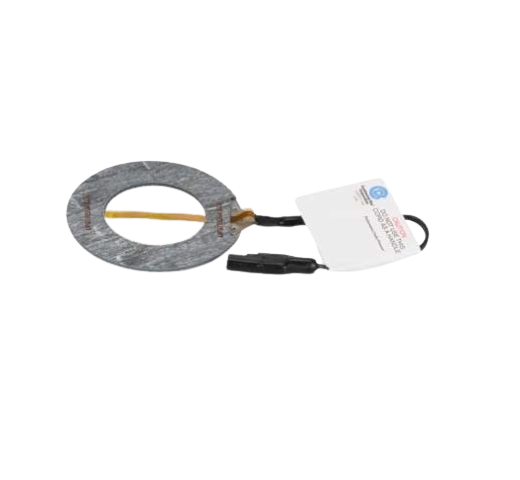
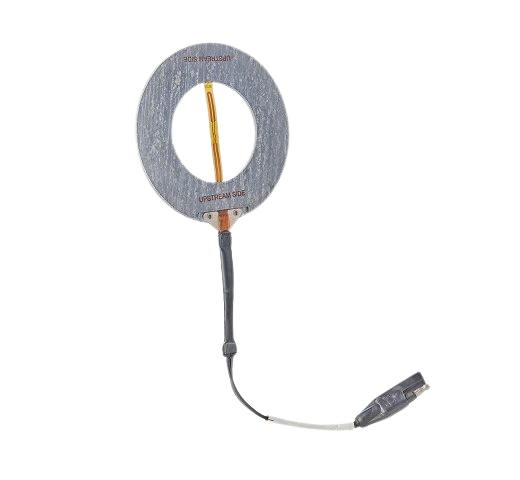
B.D.I.®, burst detector for Continental Disc rupture discs
Alarm strip with copper conductors on KAPTON® film, normally closed circuit, 24 V DC, 50 mA, -40°C to +204°C, ATEX 2014/34/EU Ex ia, integrated and universal models from DN 25 to DN 900
The heart of the system is the B.D.I.® alarm strip: copper conductors bonded to a thin KAPTON® film, with tantalum conductors for certain applications. In the integrated version, the strip crosses the seat of the rupture disc. In the universal version, it crosses the gasket face of the flange. It ends in a moulded plug or bare wires. The strip has no effect on the service life or burst pressure of the disc: reliability validated on site and in Continental Disc’s ASME-accredited flow test laboratory.
The circuit is normally closed. A low current flows continuously between the strip and the monitor. On bursting, the petal cuts the strip, the circuit opens, the relay of the corresponding channel switches and sends the signal to the control room, an indicator light or a siren, or directly triggers a pump, a valve or a shutdown procedure. A cable break gives the same signal: the system is fail-safe.
What it is for
Six situations in which the B.D.I.® should be specified: when relief alerting is essential to site safety; when a signal must trigger an automatic action, a process change or a shutdown; when you need to know immediately that an overpressure or vacuum has occurred; when loss or contamination of the product is certain if the disc is not replaced immediately; when toxic products escape through the vent; when the disc is installed in a hard-to-reach location.
Typical applications: fermenters under a gas blanket, where an undetected opening causes the batch to lose sterility; chemical reactors; process tanks; valve isolation discs, where the B.D.I.® signals that the valve is once again exposed to the fluid; valve outlets on toxic or corrosive fluids; transport tankers; pumping stations; storage and silos; distillation equipment.
Compatible with the Continental Disc discs distributed by Tubes Technologies: SANITRX LPX and SANITRX HPX® in the integrated version, HPX®, HPX®-Ta and LOTRX® in the universal version between flanges.
Characteristics
| Characteristic | Value |
| Principle | Conductive strip cut by the disc petal, normally closed circuit |
| Alarm strip | Copper conductors on KAPTON® film; tantalum conductors on request |
| Maximum current | 50 mA |
| Maximum voltage | 24 V DC RMS |
| Service temperature | -40°C to +204°C |
| Versions | Integrated (in the disc seat) or universal (in the flange gasket face), special models on request |
| Universal version diameters | 1″ to 36″ (DN 25 to DN 900) |
| Universal version flanges | ASME 150 to 600, DIN PN 10 to PN 40, JIS 2K to 40K depending on diameter |
| Universal version gasket | Asbestos-free fibre as standard, GYLON® 3500 silica-filled PTFE as an option |
| Discs in integrated version | SANITRX HPX®, SANITRX LP®, SANITRX®, CAL-VAC®, POS-A-SET®, ENVIRO-SEAL, vents |
| Discs in universal version | HPX®, ULTRX®, LOTRX®, MICRO X®, composite and standard discs |
| Connection | Sealed moulded 2-pin plug or bare wires on shielded cable |
| Cables | Shielded cable 2, 3 or 6 m; extensions from 1.8 to 91 m (6 to 300 ft) |
| ATEX | Directive 2014/34/EU: II 1 G Ex ia IIC Tx Ga, II 1 D Ex ia IIIC Tx Da, I M1 Ex ia I Ma |
| Intrinsic safety parameters | Ui 24 V DC, Ii 50 mA, Pi 0.3 W, Ci 0, Li 0 |
| Installed protection rating | IP20 minimum (IP54 for group I, mines) |
Minimum relief pressure for the universal version
Below these values, the opening energy of the disc does not guarantee that the strip will be cut. The low-pressure universal version goes down to 0.07 barg from 1″ to 4″.
| Diameter | Minimum pressure (barg) | Minimum pressure (psig) |
| 1″ (DN 25) | 1,03 | 15 |
| 1½″ (DN 40) | 0,69 | 10 |
| 2″ (DN 50) | 0,28 | 4 |
| 3″ (DN 80) | 0,17 | 2,5 |
| 4″ (DN 100) | 0,17 | 2,5 |
| 6″ to 36″ (DN 150 to DN 900) | 0,07 | 1 |
B.D.I.® alarm monitors
Each channel controls its own relay: one monitor watches several discs and identifies the one that has burst.
| Characteristic | MTB-700 | BB-100A / BB-400A |
| Number of channels | 2 or 4 | 2 (BB-100A) or 8 (BB-400A) |
| Power supply | 24 V DC, 120 V AC or 240 V AC | 115 / 230 V AC or 12 V DC |
| Output relay | DPDT form C, 5 A at 240 V AC resistive | SPDT form C, 2 A at 120 V AC resistive |
| Intrinsic safety barrier | Galvanic isolation (MTL5018 / MTL5018AC) | Zener diode |
| Barrier certifications | FM, ATEX, CSA, IECEx | None |
| Enclosure | NEMA 4, 4X, 12, 13 | No enclosure |
| Ambient temperature | -20°C to +45°C | -40°C to +40°C |
| Reset | Latching | Latching or non-latching |
| Remote test and reset | Yes / yes | No / yes |
| Audible and visual alarm | Optional | No |
Options
Tantalum conductors for media where copper would be attacked. GYLON® 3500 gasket for the universal version. Shielded cable with bare wires in 2, 3 or 6 m, or standard plug with 1.8 to 91 m extension and strain relief. Junction box recommended beyond 4.5 m of unsupported cable between strip and monitor, with shielded cable downstream to avoid false alarms. Low-pressure universal version for 1″ to 4″ discs rated down to 0.07 barg. MTB-700 monitors with or without audible and visual alarm, BB-100A and BB-400A.
Frequently asked questions
Does the B.D.I.® change the burst pressure of the disc?
No. The strip is designed to give way with the disc without contributing to its mechanical strength. Continental Disc has verified this in service and in its ASME-accredited flow test laboratory: no effect on the service life or performance of the disc.
Integrated or universal version?
The disc decides. SANITRX® sanitary discs (LPX, HPX®) and certain special discs take the integrated version, housed in the seat. Flanged discs such as the HPX®, HPX®-Ta or LOTRX® take the universal version, fitted like a gasket between the holder outlet and the downstream flange.
Does the B.D.I.® work on a very low pressure disc?
The minimum relief pressure must be checked. In the standard universal version: 1.03 barg at 1″, 0.28 barg at 2″, 0.07 barg from 6″ upwards. For a 2″ LOTRX® rated at 0.15 barg, the low-pressure universal version is required, which goes down to 0.07 barg from 1″ to 4″.
Can it be installed in an ATEX zone?
Yes. The B.D.I.® strip is certified to Directive 2014/34/EU, category 1, group IIC, up to zone 0 for gas and zone 20 for dust, with Ex ia intrinsic safety. It must be connected to an intrinsic safety barrier, such as that of the MTB-700 monitor, which is itself ATEX, FM, CSA and IECEx certified. The temperature class is marked Tx: it is set by the process temperature, as the strip does not heat up.
Can the signal go directly to the PLC?
Yes. The B.D.I.® is a simple normally closed contact: any PLC input or suitable relay can monitor it, provided that 24 V DC and 50 mA maximum are respected, and that it is routed through an intrinsic safety barrier in an ATEX zone. The MTB-700 monitor provides the barrier and dry contacts ready for wiring.
Does the strip need replacing after a burst?
Yes, the strip is cut by the disc: it is replaced along with it. It is designed for quick replacement. Plan a spare strip with each spare disc.