
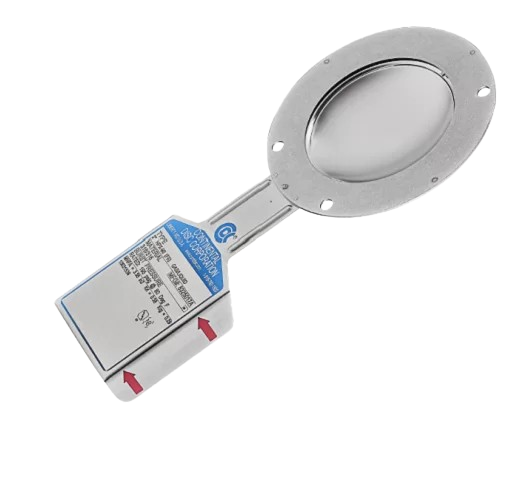
HPX® Reverse-Acting Disc
A rupture disc that holds 95% of its burst pressure in service and withstands 5 million vacuum/pressure cycles in testing, without changing the piping when the recipe changes: that is the specification of Continental Disc®’s HPX®.
Reverse-acting disc, semi-circular score, non-fragmenting, from DN 25 to DN 300 and from 0.689 to 138 barg depending on diameter and material.
It is mounted between ASME, DIN or JIS flanges in an HPX® Insert, HPX-PT® pre-torqued or double-disc holder.
HPX® Product Family brochure (PDF)
HPX® installation manual (PDF)
HPX®, reverse-acting rupture disc for the process industry
Scored semi-circular reverse-acting disc, DN 25 to DN 300, 0.689 to 138 barg, 90% or 95% operating ratio, 5 million cycles in testing, PED, ASME Section VIII, ISO 4126-2
Reverse-acting rupture disc designed as a differential-pressure relief device: instantaneous and full opening of the flow area in the event of overpressure. The dome works in compression, convex side facing the process. Precision semi-circular score: the petal opens and remains attached, with no fragments in the vent line. Bubble-tight sealing on the conical seat of the holder. Safety ratio of 1 to 1 or less: a damaged disc opens at or below its burst pressure, never above.
Each batch is manufactured to order according to the relief point specification, qualified by burst testing, and each disc undergoes a proof pressure test before shipment. Materials: 316 and 316L stainless steel, nickel, Alloy 400, Alloy 600, Alloy C276, tantalum (see the HPX®-Tadata sheet). ZERO, -5% and -10% manufacturing ranges. Two operating ratio versions: HPX-90 and HPX-95.
What it is for
A conventional forward-acting rupture disc works in tension and fatigues as soon as it approaches 70 to 80% of its burst pressure. The HPX® reverses the logic: dome in compression, 95% of burst pressure allowable in service, full vacuum without additional support. As a result, the margin between operating pressure and burst pressure drops from 20 to 30% down to 5%, and the protected equipment can operate closer to its maximum allowable pressure PS.
The HPX® is designed for multi-product facilities: short campaigns, changing fluids, shifting operating conditions. Its wide range of burst pressures and materials allows the specification to evolve under change control without touching the piping. The holder stays; the disc changes.
Typical applications: reactors, heat exchangers, chillers, isolation upstream of safety valves in chemicals; industrial gas columns and tanks, transport tankers; distillation columns, separators and coking drums in oil and gas; production tanks, mixers and mills in pharmaceuticals. For hygienic processes between clamp ferrules, see the SANITRX HPX®.
Mounted upstream of a safety valve, the HPX® isolates the valve from corrosive or fouling fluids and eliminates fugitive emissions at the valve seat. HPX® holders from 1″ to 8″ can be coupled directly under the valve; at 10″ and 12″, an intermediate spool is required.
Characteristics
| Characteristic | Value |
| Type | Reverse-acting disc, scored semi-circular, non-fragmenting |
| Diameters | 1″ to 12″ (DN 25 to DN 300) |
| Burst pressure range | 0.689 to 138 barg (10 to 2,000 psig) at 22°C depending on diameter and material |
| Manufacturing ranges | ZERO, -5%, -10% |
| Operating ratio | 90% (HPX-90) or 95% (HPX-95) of marked burst pressure |
| Burst tolerance | ±5% above 2.76 barg (40 psig); ±0.138 barg (±2 psig) at 2.76 barg and below. HPX-90 details between 2.76 and 3.45 barg: see brochure |
| Cycling resistance | 5 million cycles from full vacuum to maximum operating pressure (HPX-95 test in 316 SS) |
| Vacuum resistance | Full vacuum without vacuum support |
| Safety ratio | 1 to 1 or less |
| Fluid | Gas, steam or liquid (specify compressible or incompressible when ordering) |
| Disc materials | 316 SS, 316L SS, nickel, Alloy 400, Alloy 600, Alloy C276, tantalum |
| Maximum temperature | Nickel and Alloy 400: 427°C; 316 / 316L and Alloy C276: 482°C; Alloy 600: 538°C; fluoropolymer liner: 260°C |
| Seat | Flat, in HPX® Insert, HPX-RH, HPX-PT®, HPX-PT-RH or double-disc holder |
| Flanges | ASME, DIN and JIS |
| Sealing | Bubble-tight, metal-to-metal on the holder’s conical seat |
| National Board certified KR factor | KRG 0.29 (gas) and KRL 0.38 (liquid) in Insert and HPX-PT® holders; KRGL 0.97 in double holder |
| Codes and directives on request | PED 2014/68/EU (CE), ASME Section VIII (UD) and Section III, ISO 4126-2, Chinese licence, KOSHA, EAC CU TR |
| Burst detection | Compatible with B.D.I.® alarm system |
Burst pressure ranges by diameter, 316 / 316L / Alloy C276 disc
Minimum and maximum pressures available at 22°C, at the limits of the manufacturing range.
| Diameter | Minimum burst pressure (barg) | Maximum burst pressure (barg) |
| 1″ (DN 25) | 1,03 | 99,3 |
| 1½″ (DN 40) | 0,689 | 86,2 |
| 2″ (DN 50) | 0,689 | 75,9 |
| 3″ (DN 80) | 0,689 | 82,8 |
| 4″ (DN 100) | 0,689 | 63,4 |
| 6″ (DN 150) | 0,689 | 35,5 |
| 8″ (DN 200) | 0,689 | 23,8 |
| 10″ (DN 250) | 1,38 | 18,9 |
| 12″ (DN 300) | 1,38 | 15,5 |
Options
Fluoropolymer liner on the process side (1″ and 1½″ above 2.07 barg, 2″ to 12″ above 1.72 barg). Fluoropolymer protective cover on the vent side. Fluoropolymer coating on the process and/or vent side. Cleaning for oxygen or chlorine service. ASME (UD) stamp and CE marking per PED on request. Universal B.D.I.® burst sensor. Holders in carbon steel, 316, Alloy 400 or Alloy C276, with TANTALINE® or fluoropolymer coating: see HPX® Insert holder and HPX-PT® pre-torqued holder.
Frequently asked questions
HPX-90 or HPX-95: which should I choose?
HPX-95 whenever the operating pressure is close to the maximum allowable pressure of the equipment: 95% of burst pressure in service, ZERO manufacturing range. HPX-90 when a 10% margin is sufficient and the -5% or -10% manufacturing ranges help optimise cost. A worked example: for an operating pressure of 9 barg, an HPX-95 rated at 9.5 barg is sufficient, whereas an HPX-90 requires 10 barg. Half a bar of PS gained on the protected equipment.
Are 5 million cycles realistic in service?
It is a Continental Disc laboratory test result on an HPX-95 in 316 SS, from full vacuum to maximum operating pressure. It validates resistance to pressure/vacuum cycling. In service, temperature, corrosion and pulsation reduce this life. Continental Disc recommends a risk analysis and annual replacement of the disc, more frequently in severe conditions.
What type of burst pressure rating for the PED and for ASME?
For ASME Section VIII Division 1, the RATED burst pressure type (marked pressure) is mandatory. For CE marking under PED 2014/68/EU and the ISO 4126-2 standard, a SPECIFIED or MIN/MAX burst pressure is required. The choice is made when ordering: a single disc does not carry both.
Why specify gas or liquid when ordering?
Because Continental Disc manufactures and tests each batch for compressible (gas, steam) or incompressible (liquid) relief. A gas-qualified disc may not open correctly under a liquid surge. If a liquid relief scenario exists, it must be included in the specification.
Can an HPX® disc be refitted after removal?
No. A removed disc must not be reinstalled: risk of leakage and operation outside its burst pressure. Removal for inspection should be planned with a spare disc from the same batch, or with an HPX-PT® holder, which allows the assembly to be inspected in the workshop.
Can a reverse-acting disc protect a safety valve?
Yes, this is one of its main uses. Mounted upstream, the HPX® isolates the valve from the fluid, eliminates seat leakage and protects the internals from corrosion. To detect a leak or burst of the disc between the two, the intermediate space is fitted with a pressure gauge (tell-tale) or a B.D.I.® sensor.