
In DIN 11866, class H2 and H3 class have exactly the same interior RA: 0.80 µm. What separates them holds in one line. the weld bead. 0.80 µm required in H3, at least the double tolerated in H2. Two tubes sold under the same RA can therefore differ from single to double at the precise place where a biofilm first settles.
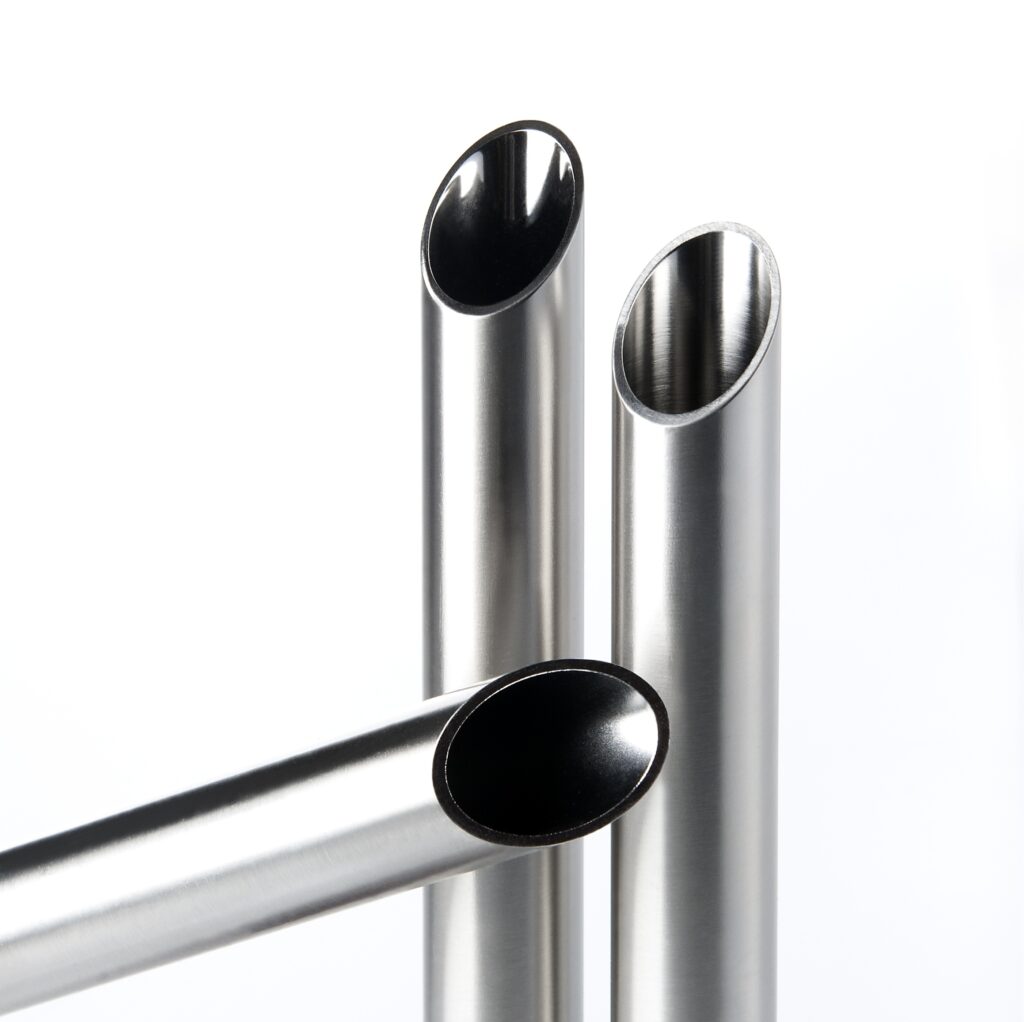
This is the whole logic of DIN 11866. It is not a catalog of diameters. It is a standard that describes a complete tube: its dimensions, its nuance, its inner surface, its welding, its outer surface, its ferrite rate, its marking and its packaging. Most specifications only cite one line. The rest still applies.
DIN 11866 is the German standard of stainless steel tubes for aseptic, chemical and pharmaceutical industries. It covers welded and seamless tubes from 6.35 mm to 219.1 mm outer diameter, intended for process pipes and fittings.
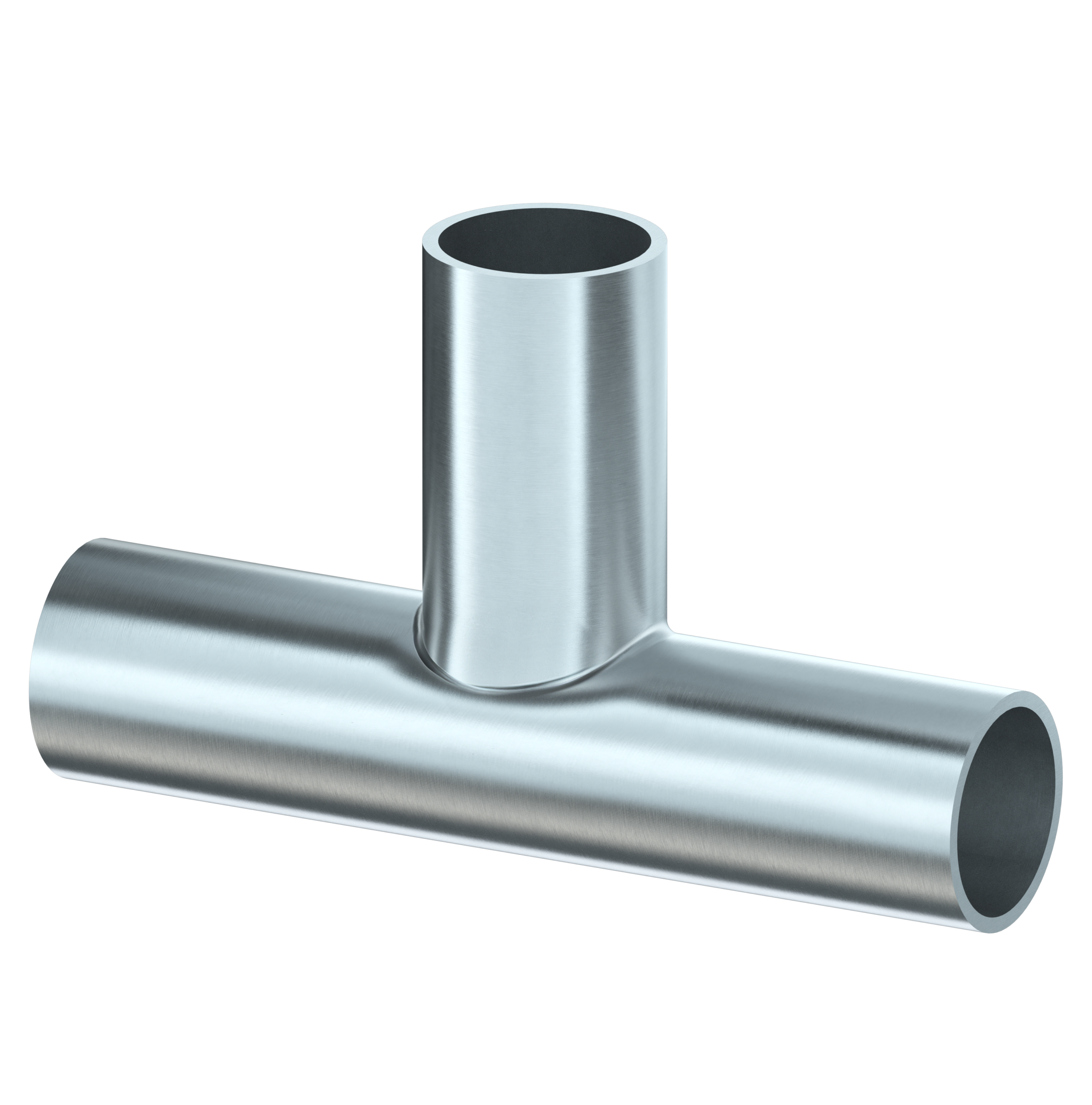
Its precise field, in the 2003 edition: dimensions, materials, interior and exterior surface conditions, and marking. It refers to the standards of manufacturing and test tubes for the rest. Once the ends are prepared, the DIN 11866 tubes are designed to be assembled by orbital welding together and with the DIN 11865 fittings (elbows, tees, reductions) and DIN 11864 (aseptic connections).
the edition in force is the DIN 11866:2016-11. It replaces editions 2008-01 and 2003-01, and applies with LEN 10088-1 for shades, LEN 10216-5 for seamless tubes and Len 10217-7 for The welded tubes. These two European standards took the place of the old DIN 17458 and DIN 17457, which the 2003 edition already announced as destined to disappear. The numerical values of this article come from the 2003 edition: the thresholds of interior roughness which fix remain those that manufacturers mark today on their tubes.
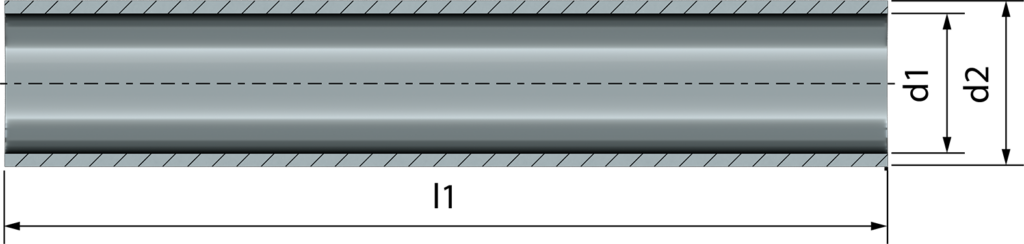
DIN 11866 does not offer a range of diameters. He offers three:
| Série A (DN : Ø ext. × ép.) | Série B (Ø ext. × ép.) | Série C (pouce : Ø ext. × ép.) |
|---|---|---|
| DN 6 : 8 × 1,0 | 10,2 × 1,6 | 1/4" : 6,35 × 0,89 |
| DN 8 : 10 × 1,0 | 13,5 × 1,6 | 3/8" : 9,53 × 0,89 |
| DN 10 : 13 × 1,5 | 17,2 × 1,6 | 1/2" : 12,70 × 1,65 |
| DN 15 : 19 × 1,5 | 21,3 × 1,6 | 3/4" : 19,05 × 1,65 |
| DN 20 : 23 × 1,5 | 26,9 × 1,6 | 1" : 25,40 × 1,65 |
| DN 25 : 29 × 1,5 | 33,7 × 2,0 | 1 1/2" : 38,10 × 1,65 |
| DN 32 : 35 × 1,5 | 42,4 × 2,0 | 2" : 50,80 × 1,65 |
| DN 40 : 41 × 1,5 | 48,3 × 2,0 | 2 1/2" : 63,50 × 1,65 |
| DN 50 : 53 × 1,5 | 60,3 × 2,0 | 3" : 76,20 × 1,65 |
| DN 65 : 70 × 2,0 | 76,1 × 2,0 | 4" : 101,60 × 2,11 |
| DN 80 : 85 × 2,0 | 88,9 × 2,3 | 6" : 152,40 × 2,77 |
| DN 100 : 104 × 2,0 | 114,3 × 2,3 | |
| DN 125 : 129 × 2,0 | 139,7 × 2,6 | |
| DN 150 : 154 × 2,0 | 168,3 × 2,6 | |
| DN 200 : 204 × 2,0 | 219,1 × 2,6 |
Dimensions en mm, d'après la DIN 11866:2003-01, tableau 2.
A detail that few buyers notice: in series A, the inner diameter is equal to the DN. A DN 25 tube is 29 mm on the outside and 26 mm on the inside, a DN 50 is 50 mm of passage. The calculation of flow and speed is therefore done directly on the nominal value, which partly explains the longevity of the A series in European purified water loops.
Another practical point: after a finishing treatment (breaking, polishing, electro-polishing), the minimum allowed thickness can be reduced by 0.05 mm. An electropolished tube is not a tube out of tolerance.
Series C deserves a comment. It takes up the dimensions of Lasme BPE. A tube can therefore be “DIN 11866 Series C” and at ASME BPE ratings at the same time. The two norms do not oppose geometry: they overlap. We have detailed what LASME BPE covers beyond the dimensions in our Article on the ASME BPE standard and its range of parts.

This is the most cited part of the norm, and the worst read. Each class fixes three things: the RA of the inner surface, the RA of the inner welding bead, and the condition of the outer surface.
| Classe | Classe électropolie | Ra intérieur | Ra du cordon intérieur |
|---|---|---|---|
| H1 | HE1 | < 1,60 µm | < 3,20 µm |
| H2 | HE2 | < 0,80 µm | < 1,60 µm * |
| H3 | HE3 | < 0,80 µm | < 0,80 µm |
| H4 | HE4 | < 0,40 µm | < 0,40 µm |
| H5 | HE5 | < 0,25 µm | < 0,25 µm |
D'après la DIN 11866:2003-01, tableau 3. * Pour le cordon en classe H2, l'extrait de l'édition 2008 publié par certains fabricants indique < 3,20 µm.
Three readings are in order.
The first is the H2 / H3 paradox seen in the introduction: same wall RA, cord at least twice as rough in H2. For a critical fluid, the H2 class is not “almost an H3”. It is an H3 with a less demanding weld, precisely where the defects are concentrated.
The second is the meaning of the letter E. A class He is not only “smoother”. It is an electro-polished tube according to a standardized procedure which removes at least 20 µm of material. The electropolishing does not correct a bad tube, it removes a layer of a known thickness of a tube already in accordance with its H-Class. This is the reason why a HE5 necessarily starts from an H5 base.
The third is the rise in class. The standard allows a tube to pass from a lower class to a higher class through additional treatment: polishing, break-in. A class H4 is therefore not always a “born H4” tube. It can be a reworked H3 tube. This is not a defect, but it is information that the buyer has an interest in knowing.
The suffix “O” is the least understood element of designations DIN 11866. It has nothing to do with the inner surface. It indicates that the surface outside of the tube is polished, with a Ra less than 0.80 µm in the 2003 edition.
Without suffix, the outer surface of an H3 to H5 tube is simply pickled or glossy annealed, with no special roughness requirements. With the suffix “O”, it is polished and measured. Moreover, the standard imposes a specific measurement program for these tubes: longitudinal surveys on the outer surface, at least 100 mm from the end.
Why does it count in pharmaceuticals? Because the outer surface of a clean room piping is cleaned, disinfected, inspected. An H4 and an H4O have the same fluid side surface. On the room side, not at all.
At Dockweiler, the four references in the Liquid range all carry the suffix:
| Classe DIN 11866 | Finition intérieure | Ra intérieur max. | Référence Dockweiler |
|---|---|---|---|
| H3o | Recuit brillant (BF) | 0,80 µm | Weldtron BF |
| HE3o | Électropoli (EP) | 0,60 µm | Weldtron EP |
| H4o | Recuit brillant (BF) | 0,40 µm | Safetron BF |
| HE5o | Électropoli (EP) | 0,25 µm | Safetron EP |
The Weldtron EP is classified as HE3O but guarantees 0.60 µm, where class 3 tolerates 0.80 µm. We have detailed the choice of these fluid references by fluid (EPPI, pure vapor, air process) in our Article on the roughness of pharmaceutical stainless steel tubes.
The norm is not satisfied with an RA. It associates with each class of typical manufacturing methods, identified by a code from the tube manufacturing standards:
| Code | Mode de fabrication |
|---|---|
| k2g | Tube soudé à partir de feuillard laminé à froid, cordon intérieur arasé, traité thermiquement et décapé |
| k3g | Même fabrication, traité thermiquement sans calamine (atmosphère protectrice) au lieu d'être décapé |
| l2 | Tube soudé puis rétreint à froid (draw-polished), traité thermiquement sans calamine |
| n2 | Tube sans soudure étiré à froid, traité thermiquement sans calamine |
Correspondence with classes is instructive. Classes H1 to H3 are with welded tubes K2G or K3G (and, in H2, with a seamless tube N2). The H4 class is directly with an L2 or N2 tube, but a K2G or K3G tube only with a polishing or additional break-in. The H5 class is only achieved, regardless of the basic tube, with additional treatment: polishing, lapping or electropolishing.
In other words, under the same “H4” can hide two different industrial stories: a cold shrunk tube that comes out of manufacture, or a standard polished welded tube after the fact. The manufacturing code is part of the standardized designation. Just want to do so.
DIN 11866 retains three shades according to LEN 10088-1:
| Nuance | Désignation symbolique | Équivalent ASTM courant |
|---|---|---|
| 1.4404 | X2CrNiMo17-12-2 | 316L |
| 1.4435 | X2CrNiMo18-14-3 | 316L à teneurs relevées |
| 1.4539 | X1CrNiMoCu25-20-5 | 904L (UNS N08904) |
A point often surprises: the norm designates the 1.4435 as standard material, not 1.4404. Other shades of Len 10088-1 can be agreed separately.
The material comparison appendix reveals a second deviation, on sulfur. 1.4404 and 1.4435 according to LEN 10088-1 are limited to 0.015% sulfur. The 316L according to ASTM A269 / A270 tolerates up to 0.030%. twice as much. For orbital welding, where a sulfur gap between two parts can deflect LARC, “316L” and “1.4435” are not interchangeable on a purchase order.
Third subject: the delta ferrite. Cold forming can create martensite, magnetic, which distorts ferrite measurement. DIN 11866 tubes are therefore delivered in the hyper-disted state (set in solution between 1020°C and 1150°C depending on the nuance). The permissible delta ferrite content can be added to the order, in three classes:
| Classe DF | Delta ferrite à l'état de livraison |
|---|---|
| DF 1 | ≤ 3,0 % |
| DF 2 | ≤ 1,0 % |
| DF 3 | ≤ 0,5 % |
The two ranges Dockweiler, Weldtron and Safetron, are offered in 1.4435 BN2 with a delta ferrite rate less than or equal to 0.5%, including in the weld: they are both at the level of the class DF 3. If the DF class is agreed, the standard requires that it be checked and documented on two tubes per production batch.
DIN 11866 also fixes what the receiver must be able to verify.
roughness This is measured according to DIN EN ISO 4287, RC filter, probing length of at least 4.8 mm, cut-off of 0.8 mm. At least two internal measurements per test batch, at least 5 mm from the end, in longitudinal and, from 10 mm in diameter, cross-section. For classes H1 to H3 and HE1 to HE3, the cord area should be measured in particular.
Visual acceptance criteria, taken from Lasme BPE, are encrypted: isolated craters of 0.5 mm maximum diameter with glossy bottom, scratches less than 6 mm long and 0.1 mm deep, visual marks limited to 5% of the total surface, RA respected In all cases. Cracks, notches, crater accumulations and surface residues are not allowed. Cord defects are assessed at quality b.
cleanliness : Tubes free of grease and oil, shiny metal surface, no dried traces, including before any heat treatment.
The marking, permanent: manufacturer symbol, outer diameter and thickness, material number, reference DIN 11866 with the symbol of manufacture, and casting number.
Packaging : Tubes delivered dry, tubes polished in polyethylene sheath, plugged ends, transport in closed container whenever possible.
The standard gives, for information purposes, the permissible operating pressures under static load, calculated for 1.4404 according to DIN 2413-1. Some values:
| Tube | À 20 °C | À 150 °C |
|---|---|---|
| Série A, DN 25 (29 × 1,5) | 165 bar | 105 bar |
| Série A, DN 50 (53 × 1,5) | 90 bar | 57 bar |
| Série A, DN 100 (104 × 2,0) | 61 bar | 39 bar |
| Série B, 60,3 × 2,0 | 106 bar | 67 bar |
| Série C, 2" (50,80 × 1,65) | 104 bar | 66 bar |
| Série C, 4" (101,60 × 2,11) | 66 bar | 42 bar |
D'après la DIN 11866:2003-01, annexe C (informative).
two lessons. From 20°C to 150°C, the allowable pressure loses more than a third, on all series. And on a comparable diameter, the B series (60.3 × 2.0) holds more than the A series (53 × 1.5) thanks to its thicker wall. These values are orders of magnitude, not calculation pressures: a real project is sized with its nuance, vapor temperature, water hammers and calculation code.
The standard sets the designation format. His own example, in the 2003 edition:
Tube DIN 11866 — 35 × 1,5 — DIN 17457 PK 2 — 1.4435 — H4o — l2Either, in order: the reference of the norm; the outer diameter and thickness (series A, DN 32); the manufacturing and test standard with its test class (welded tube, test class 2); the nuance; the hygiene class with its external suffix; The manufacturing code (welded, cold shrink).
In the 2016 edition, the manufacturing reference refers to LEN 10217-7 for welded tubes and LEN 10216-5 for seamless tubes. The logic remains the same: six fields, and none is decorative.
When ordering, include the quantity, the lengths (manufacturing lengths or fixed lengths, for example 6,000 mm +5/0 mm) and the material certificate according to LEN 10204 (3.1).
Compare with the line that we still read in many specifications: “316L polished stainless steel tube”. It does not fix the series, nor the class of hygiene, nor the welding, nor the external state, nor the real nuance, nor the method of manufacture. Six unknowns. Each is paid for in reception.
DIN 11866 qualifies a tube. lASME BPE Qualifies an installation: materials, hygienic design, welding, finishes (classes SF1 to SF6), certification. The two meet on two points. Series C of DIN 11866 takes over ASME BPE ratings. And the same tube can carry a DIN hygiene class (H4O, for example) while satisfying an ASME BPE contract requirement (SF1, for example). Two languages, one tube.

Ancien ingénieur mise en route et expert traitement d'eau dans un grand groupe alimentaire, puis chargé d'affaires en pharmaceutique, microélectronique et agroalimentaire. Profil LinkedIn

Dockweiler ranges EN 1.4435 BN2, Delta Ferrite class DF 3, distributed by Tubes Technologies, stock in Mions (69).
At Tubes Technologies, each DIN 11866 tube is offered with its complete designation: series, nuance, hygiene class, external suffix, method of manufacture and certificate, on the Weldtron (H3O, HE3O) and Safetron (H4O, HE5O) from our partner Dockweiler.
 Guide de sélectionRugosité des tubes inox pharmaceutiques : ce que le Ra ne vous dit pasRa, classes DIN 11866, grille de spécification par fluide, soudure orbitale, rouging.Lire l'article →
 Article pilierASME BPE : ce que dit la norme, et toutes les pièces qui composent sa gammeLes 13 Parts de l'édition 2026 reliées à la gamme : matières, finitions SF1 à SF6, raccords, vannes.Lire l'article →
 Glossaire visuelGlossaire visuel ASME BPE Part DT : la photo de chaque code32 codes Part DT en photo : coudes, tés, réductions, ferrules et bouchons, avec leur fiche produit.Lire l'article →