
On a line of 2″ to 5 m³/h water, a 16.4 mm orifice creates 0.5 bar of pressure drop. Formula, table from 1″ to 3″, choice of model and adjustment on site: the method for dimensioning a clamp joint at Port without adjustment valve.
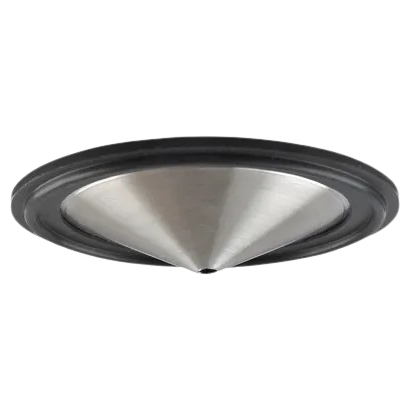
One Orifice clamp seal is a tri-clamp sanitary seal in which is set a stainless steel plate pierced with a calibrated hole. The diameter of this hole fixes the pressure drop, therefore the flow rate, to the joint plane, without valve or additional tapping. On a line of 2″ to 5 m³/h water, a 16.4 mm orifice creates approximately 0.5 bar of permanent pressure drop.
All the sizing fits in this relationship between the flow rate, the targeted pressure drop and the orifice diameter. This article gives the formula, an array of diameters from 1″ to 3″ and the rules of choice of the model.
A hole plate creates a fixed restriction. Passing through the lorifice, the fluid accelerates, its pressure drops, then it partially goes downstream. The part that does not go up is the permanent pressure drop, that which regulates the flow.
In a pharmaceutical or biotech installation, the orifice clamp seal is used for four uses:
The interest compared to an adjustment valve: no valve body, no dead arm added, no drift setting. The plate mounts between two ferrules instead of a standard joint. The SD share of BPE lasme Also cite the orifice plates among the components of the hygienic systems.
The flow that passes through a sharp-edged port follows Liso 5167-2:
Q = c × (π × d² / 4) × √(2 × Δp / (ρ × (1 − β⁴)))The permanent pressure drop is lower than Δp, because part of the pressure recovers downstream. For β between 0.3 and 0.4, it is 82 to 90% of Δp. For β = 0.6, it drops to 63%.
For a first calculation, when β remains below 0.4, the term (1 − β⁴) is close to 1 and the formula is simplified:
d ≈ √( 4 × q / (π × c × √(2 × Δp / ρ)) )The table below gives the diameter for a speed of 1.5 m/s in the tube, a current value in purified water circuit and in CIP. Tubes with ASME BPE dimensions (1.65 mm thick), water at 20°C.
| Tube (Ø ext. × ép.) | Ø intérieur | Débit à 1,5 m/s | Orifice pour 0,2 bar | Orifice pour 0,5 bar | Orifice pour 1 bar | Orifice pour 2 bar |
|---|---|---|---|---|---|---|
| 1" (25,4 × 1,65) | 22,1 mm | 2,1 m³/h | 12,2 mm | 10,1 mm | 8,7 mm | 7,5 mm |
| 1 1/2" (38,1 × 1,65) | 34,8 mm | 5,1 m³/h | 19,2 mm | 16,0 mm | 13,7 mm | 11,7 mm |
| 2" (50,8 × 1,65) | 47,5 mm | 9,6 m³/h | 26,2 mm | 21,8 mm | 18,8 mm | 16,0 mm |
| 3" (76,2 × 1,65) | 72,9 mm | 22,5 m³/h | 40,2 mm | 33,5 mm | 28,8 mm | 24,6 mm |
Perte de charge permanente visée. Calcul selon l'équation de l'ISO 5167-2, coefficient de décharge 0,61. Ordre de grandeur, pas une valeur de projet.
two useful readings. Dividing the pressure drop by ten only gains a factor of 1.6 to 1.8 on the diameter: the header diameter varies as the fourth root of the pressure drop. And a 1 mm error when drilling a 10 mm orifice changes the pressure drop from 30 to 50%, because it varies as the reverse of power four of the diameter. The precision of the drilling matters more than that of the calculation.
A 2″ ASME BPE Tube Loop Branch (47.5 mm inner Ø) should be limited to 5 m³/h, with a permanent pressure drop of 0.5 bar.
For LEPPI at 80°C, the density drops to 972 kg/m³ and the diameter gap remains below 1%.
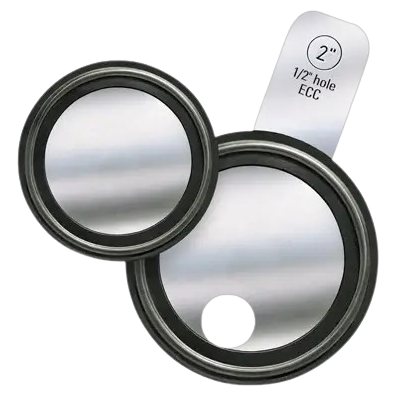
The orifice clamp joint comes in three executions. The choice depends on the orientation of the line and when the diameter is frozen.
| Modèle | Description | Quand le choisir |
|---|---|---|
| Plaque pleine non percée | Livrée sans trou, à percer après calcul | Le diamètre n'est pas encore figé, ou vous percez vous-même |
| Plaque plate prépercée concentrique | Alésage centré | Ligne sans contrainte de vidange |
| Plaque plate prépercée excentrée | Alésage en bas de veine | Ligne horizontale qui doit se vidanger sans rétention, par exemple un circuit CIP |
| Plaque verticale conique | Plaque conique orientée vers le bas | Conduite verticale : une plaque plate y retiendrait le liquide. Jusqu'au 4" |
On an eccentric plate, the hole is drilled opposite the tongue. The tongue rises upwards, which places the lorifice at the bottom of the vein. The visual cue becomes an editing mark.
| Caractéristique | Valeur |
|---|---|
| Plaque | Inox 316L, électropolie en standard |
| Rugosité de plaque | 0,8 µm à 0,38 µm électropolie (EP) |
| Joint | EPDM, FKM, silicone, PTFE ou Steam-Flon |
| Liaison joint / plaque | Élastomère lié en standard, joint amovible en option |
| Tailles | 1/2" à 6", jusqu'au 4" pour le modèle vertical |
| Normes de raccord | DIN 32676 série A, série B (ISO 1127), série C (ASME BPE) |
| Conformité | FDA et USP Class VI |
| Options | Languette gravable au laser, service de perçage |
The bonded joint is replaced with its plate in case of failure. The removable seal is justified when you drill the plates yourself: it avoids contaminating the elastomer during the machining.
The plate stiffens the joint: a clamp that is too tight or misaligned pipes damage it faster than a full joint. the compression is taken at the torque prescribed for the collar, and a Safx Safety Clamp Collar Avoids the accidental opening of a fitting that has a restriction.
The orifice clamp seal and the adjustment valve meet the same need, limit a flow, but not with the same constraints. The choice depends above all on the stability of the target flow and the cleanability requirements of the line.
| Critère | Joint clamp à orifice | Vanne de réglage à membrane |
|---|---|---|
| Débit | Fixe, défini par le diamètre d'orifice | Réglable en exploitation |
| Bras mort ajouté | Aucun : la plaque est au plan de joint | Corps de vanne et ses raccords |
| Dérive du réglage | Aucune, sauf usure de l'orifice | Possible après démontage ou maintenance |
| Encombrement | Épaisseur d'un joint | Corps de vanne, actionneur ou volant |
| Nettoyage CIP et SIP | Plaque lisse, 0,8 µm à 0,38 µm EP, drainable en version excentrée ou verticale | Membrane à qualifier, rétention possible selon l'orientation |
| Qualification | Un diamètre à documenter | Position de réglage à verrouiller et à vérifier |
| Changement de consigne | Remplacer le joint clamp à orifice | Tourner le volant |
In practice, the orifice clamp joint is imposed on the loop branches and returns whose flow does not change. The valve remains necessary where the flow rate is to vary depending on the production. The two often combine: a valve to adjust during commissioning, then a calibrated orifice plate to freeze the adjustment obtained.
On site, the door diameter is most often adjusted by tests, in particular on the EPPI sampling points. The calculation gives the starting point, the test gives the final value: the actual pressure losses of the sampling valve, output and loop always move a little from the model.
The method consists of pre-drilling a small diameter orifice clamp joint, and then growing in stages to the desired flow rate, measured under the standard operating conditions.
Each drilling is done outside the clean zone, followed by deburring and cleaning the plate before reassembly. The removable joint is the right choice here: it is removed during machining and is not likely to be contaminated by chips. This method makes the setting reproducible: the same orifice clamp joint, reassembled after maintenance, restores the same flow rate at the sampling point.
A port clamp seal cannot be seen, collar closed. This is the weak point of the solution: a plate forgotten during a maintenance, or reassembled in the wrong branch, unbalances the whole loop. The tab that protrudes from the fitting signals the in-line plate. Laser engraved with the header diameter, it allows you to check the correct plate without disassembling. it is the same logic as the Engraved clamp joint : travel information with the room.

Ancien ingénieur mise en route et expert traitement d'eau dans un grand groupe alimentaire, puis chargé d'affaires en pharmaceutique, microélectronique et agroalimentaire. Profil LinkedIn

Clamp Joint Clamp and Clamp Fitting Components, FDA/USP Class VI, distributed by Tubes Technologies.
Send us the flow rate, fluid, temperature and load loss targeted: our technical team calculates the diameter and can deliver the clamp seal with an already drilled orifice, with engraved tongue.
 Article pilierASME BPE : ce que dit la norme, et toutes les pièces qui composent sa gammeLes Parts de l'édition 2026 reliées à la gamme, dont la Part SD et ses plaques à orifice.Lire l'article →
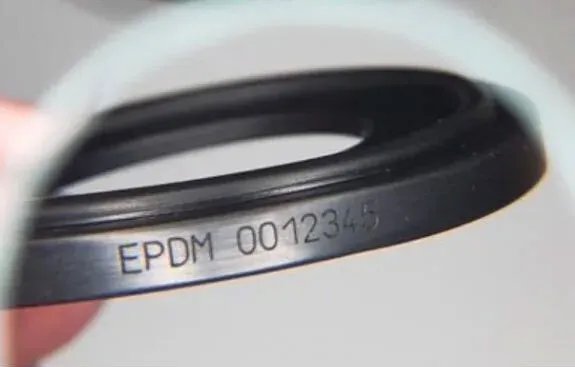 TraçabilitéJoints clamp gravés : la traçabilité qui survit au sachetNuméro de lot gravé au laser, lisible après montage et SIP.Lire l'article →