
Two years of investigation for particles in a tank. Everyone knew what type of joint to look for. No one knew which one was up, nor from what lot he came from.
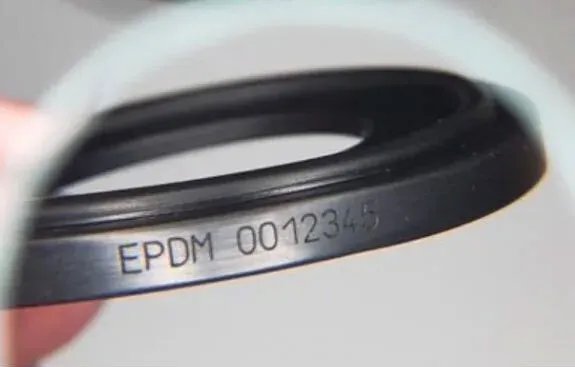
Annex 1 of GMPs does not require engraving a batch number on a clamp joint anywhere. It requires something else, more difficult: to be able to demonstrate, piece by piece, the mastery of everything related to the product. The engraved clamp joint is the easiest way to hold this requirement once the seal has left its bag.
Today, the traceability of a clamp joint is based on the label of its bag. As soon as the seal is taken out of the packaging and mounted on the installation, this documentary link is broken. The material certificate still exists. He no longer follows the room.
A sterile production site receives four to five inspections per year: ANSM, FDA, customers, internal audits. LANSM can happen without warning. The essential is played on the documents, and one day, the inspector’s finger falls on the maintenance of an EPPI loop.

A few dozen clamp joints, from 12.7 to 63.5 mm. PTFE, EPDM coated PTFE. SIPs at 121.1°C for 20 minutes, every week or every quarter depending on the loop. Simple question: this joint, which lot, which certificate, asked when?
The good news: the certificate exists. The worst: he sleeps in a binder, and the joint left his bag eight months ago.
The revised Annex 1 (“Manufacture of Sterile Medicines”) was published by the European Commission on August 25, 2022. It has been applied since August 25, 2023, and since August 25, 2024 for its item 8.123 on freeze dryers. In France, it constitutes the guideline LD.1 of the LANSM GMP Guide. The sterile production sites have been revising since their supplier requirements, in particular for elastomers in product contact.
The text is not about engraving. He talks about evidence. Five points directly affect the clamp joint:
| Point de l'Annexe 1 | Ce que dit le texte | Conséquence pour le joint clamp |
|---|---|---|
| 2.3 | Une stratégie de contrôle de la contamination (CCS) définit tous les points critiques de contrôle et l'efficacité des moyens de maîtrise. | Le joint en contact produit est un point critique : sa matière, sa conformité et sa durée de vie doivent être justifiées. |
| 2.5 | La CCS couvre notamment les équipements, l'agrément des fournisseurs de composants clés et la maintenance préventive. | Une fréquence de remplacement doit être définie et prouvée. Sans identification, impossible de savoir depuis quand un joint est en place. |
| 3.2 | Toute non-conformité fait l'objet d'une investigation ; l'inclusion ou l'exclusion de chaque lot doit être justifiée et enregistrée. | Un fragment de joint ou une fuite après SIP doit pouvoir être rattaché à son lot et à son certificat matière. |
| 5.7 | Une maintenance non planifiée sur un équipement critique pour la stérilité impose une évaluation d'impact enregistrée. | Le joint remplacé en urgence doit être identifié, comme celui qu'il remplace. |
| 8.129 | L'intégrité des composants des connexions aseptiques est assurée et documentée dans la CCS ; l'évaluation des fournisseurs inclut les modes de défaillance. | Le fournisseur de joints doit pouvoir documenter matière, lot et tenue en service. |
Paraphrase du texte, d'après l'Annexe 1 des BPF (LD.1 du guide des BPF, ANSM).
Annex 1 does not impose engraving as such. It requires demonstrating mastery of each element that can contaminate the product, and the joint in contact produced is one of them. The engraved joint clamp removes the weak link: dependence on a sachet or label that does not follow the part.
At the first deviation, particles or a leak after SIP, the batch is blocked. Point 3.2 then becomes very concrete: it is necessary to justify in writing each lot included in the investigation or excluded from its scope.
Without a legible lot on the part, everything that has turned with “this type of joint” becomes suspicious. On a site that produces 5 to 6 lots per week, at €500,000 per lot, each week of production that cannot be excluded represents 2.5 to 3 million euros under investigation. Faced with this figure, the unit additional cost of an engraved clamp joint is negligible.
The CCS is the client who writes it. It is he who defends her before the inspector. as much as he has the proofs in hand.

An ophthalmic gel combines the factors that make individual joint traceability essential:
For this type of site, an unidentifiable joint after assembly is a potential deviation during an inspection. The engraved clamp seal closes this door.
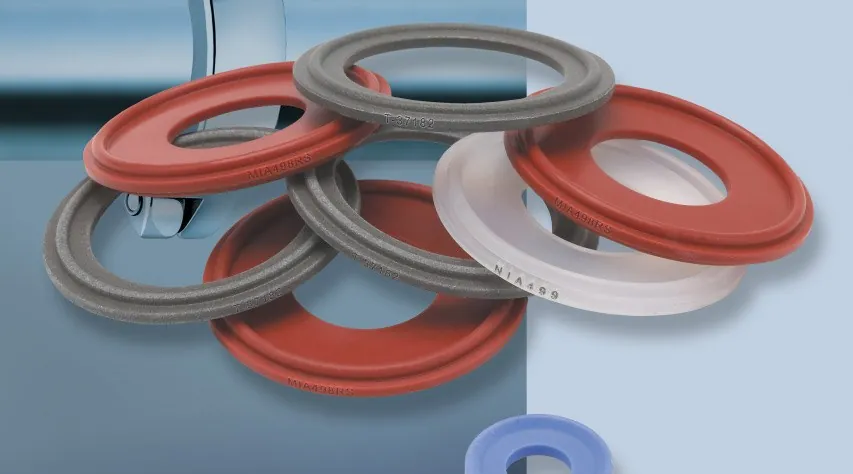
At Tubes Technologies, the engraved clamp joint is an option: laser engraving of the batch number is asked when ordering, on the clamp FDA / USP Class VI clamp joints. It is not systematic. The marking does not make any material: neither ink nor label. It is placed on the outer collar, out of the fluid vein and out of the wet area, and remains legible once the collar is tight. It is due to SIP cycles. The certificate of conformity of the lot bears the same number: the proof travels with the part.
The proposed marked data: the manufacturer’s batch number, the material code (SIL, EPDM, PTFE, etc.) and the nominal size. A specific marking, for example the equipment marker, can be added at the customer’s request. The engraved material code replaces the color dot that some manufacturers use to identify the elastomer: a pellet reads badly, a text reads.
Sizes, engravable materials and marking contents vary from manufacturer to manufacturer. Depending on the ranges, the engraving covers the clamp joints from 1/2″ to 4″, i.e. tubes from 12.7 to 101.6 mm in outer diameter: the entire range of a current EPP loop. It applies to silicone, LEPDM, FKM, PTFE, Buna (NBR), PTFE / stainless steel composites such as seals tuf-steel and tuff-flex, and sometimes to orifice plates and sieves. Manufacturers announce a legible marking throughout the service life of the seal; Some also certify their ADI Free joints (without animal ingredient).
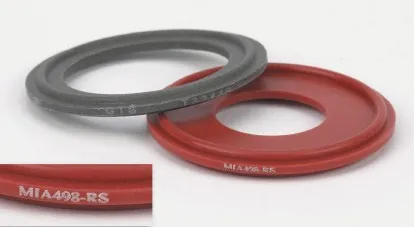
We work with several engraved clamp joint manufacturers: Dockweiler, Newman Sanitary Gasket, Rubber Fab and Techné. Our role: source the engraved joint clamp adapted to each site, according to its preferences (manufacturer already qualified, material, execution) and its regulatory requirements (FDA, USP Class VI, ADI Free, Annex 1 of GMPs). Several qualified sources also secure the supply.
| Matière gravée | Exécution | Fiche produit |
|---|---|---|
| Silicone (platine) | Type I sans lèvre ou type II à lèvre de centrage, selon matière | Joint clamp silicone |
| EPDM | Type I ou type II selon matière | Joint clamp EPDM |
| FKM (Viton) | Type I ou type II selon matière | Joint clamp FKM |
| PTFE | Type I ou type II selon matière | Joint clamp PTFE |
| PTFE enveloppé (jaquette) | Selon matière | Joint clamp revêtu PTFE |
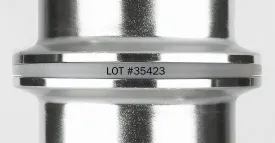
An engraved clamp joint is only used if it is connected to the site’s quality system. The chain is in five links:
Marking an engraved clamp seal should not create any new risk of contamination. Four points are to be justified, and each directly feeds the customer’s supplier qualification and CCS:
| Point de contrôle | Exigence | Preuve à fournir |
|---|---|---|
| État de surface | Aucune altération de la face d'étanchéité ni de la face en contact produit | Plan de marquage, photo, contrôle visuel |
| Particules | Aucun résidu ni débris lié au marquage | Procédé sans encre ni étiquette, nettoyage après marquage |
| Extractibles / relargables | Profil inchangé par rapport au joint non marqué | Déclaration fabricant ou données d'essai |
| Conformité matière | FDA et USP Class VI maintenues | Certificat du lot reprenant le numéro gravé |
For elastomers and standard sealing, see also our article on theASME BPE (Part PM and Part MC).

Ancien ingénieur mise en route et expert traitement d'eau dans un grand groupe alimentaire, puis chargé d'affaires en pharmaceutique, microélectronique et agroalimentaire. Profil LinkedIn

FDA / USP Class VI clamp seals, available in engraved clamp seal (laser batch number) on request to order, distributed by Tubes Technologies.
To switch to the engraved clamp joint, identify with our team the sizes, materials and quantities of your loops, validate the content of the marking, then receive samples engraved with their standard certificate before the first order.
 Article pilierASME BPE : ce que dit la norme, et toutes les pièces qui composent sa gammeLes 13 Parts de l'édition 2026 reliées à la gamme : matières, finitions SF1 à SF6, raccords, vannes.Lire l'article →
 Guide de sélectionRugosité des tubes inox pharmaceutiques : ce que le Ra ne vous dit pasRa, classes DIN 11866, grille de spécification par fluide, soudure orbitale, rouging.Lire l'article →
 NormeDIN 11866 : ce que dit vraiment la norme des tubes inox aseptiquesSéries A, B, C, classes d'hygiène H1 à H5, suffixe « o », delta ferrite, désignation complète.Lire l'article →